The hail stops, you walk outside, and the roof looks fine from the driveway — so you do nothing. That single decision costs Calgary homeowners more money than the storm itself. Filing a hail damage roof insurance claim correctly, and quickly, is the difference between a fully covered roof replacement and a five-figure bill you pay yourself. Calgary sits in the middle of Canada’s hail alley, and Alberta has absorbed roughly $8 billion in hail damage over the past decade. This 2026 guide walks you through the claim process step by step: what to do in the first 72 hours, what documentation adjusters actually accept, how the shift toward depreciated payouts is changing what you receive, and what to do when a claim comes back denied or short.
Table of Contents
Key Takeaways
- Report hail damage to your insurer promptly — most policies require notice “as soon as reasonably possible,” and long delays give insurers grounds to dispute the cause.
- Get an independent roof inspection before the adjuster visits, not after. Documented damage is far harder to negotiate away.
- Much hail damage is invisible from the ground: bruised shingles, lost granules, and fractured mats often show no obvious hole.
- Many Alberta policies now shift older roofs to Actual Cash Value, paying a depreciated amount rather than the full cost of a new roof.
- A denied or underpaid claim is not the end — a detailed contractor report and a formal reinspection request reverse a meaningful share of them.
Hail roof claims: the quick answer
To file a hail damage roof insurance claim in Calgary: document the storm date, have a qualified roofing contractor inspect and photograph the damage, notify your insurer promptly, meet the adjuster on site with your contractor present, and compare the adjuster’s scope against your contractor’s report before you accept any settlement. The two steps homeowners skip most often — an independent inspection before the adjuster arrives, and having someone on your side during the inspection — are the two that most affect what you are paid.
The claim itself is not complicated. What makes hail claims difficult is that the damage is technical, partially invisible, and assessed by someone whose scope of work sets the payout. Going in with your own documented evidence changes that conversation entirely.
The first 72 hours after a Calgary hailstorm
What you do in the days right after a storm shapes the entire claim. Start on the ground, where it is safe. Photograph dented eavestroughs, downspouts, siding, window screens, air conditioner fins, decking, and any vehicles — these are the “collateral indicators” adjusters use to confirm a hail event actually struck your address, and they are often easier to prove than the roof itself.
Check your eavestroughs and the base of your downspouts for granules. A heavy accumulation of the sand-like coating from your shingles is one of the clearest signals that the hail was severe enough to strip the roof’s protective layer. Note the exact date and approximate time of the storm; insurers verify claims against weather data, and a wrong date creates avoidable friction.
Do not climb onto the roof yourself. Hail bruising is subtle, roofs are dangerous after a storm, and walking on freshly impacted shingles can cause damage that complicates your claim. Book a professional inspection instead — our residential exterior inspection checklist covers exactly what to record before you call your insurance company.
Finally, prevent further damage. Insurers expect you to mitigate: tarp an active leak, move belongings out of the way, and keep receipts for anything you spend doing it. Those costs are commonly reimbursable, and failing to mitigate can reduce a payout.
The claim process, step by step
A hail damage roof insurance claim in Calgary follows a predictable sequence. Knowing the order lets you get ahead of each stage rather than react to it.
| Step | What happens | What you should do |
|---|---|---|
| 1. Independent inspection | A roofing contractor documents damage and produces a written report | Book this first, before you call the insurer |
| 2. Notify insurer | A claim number is issued and an adjuster is assigned | Give the storm date and describe damage factually |
| 3. Adjuster inspection | The adjuster assesses the roof and writes a scope of work | Have your contractor on site for the inspection |
| 4. Scope review | You receive an estimate and settlement amount | Compare line by line against your contractor’s report |
| 5. Supplement or dispute | Missed items are added, or a reinspection is requested | Submit written evidence, not verbal objections |
| 6. Repair and final payment | Work is completed and holdback released | Keep every invoice and completion document |
The step homeowners underestimate is the fourth. An adjuster’s scope is an opinion about what work the damage requires, and opinions differ — often by thousands of dollars, and usually on the items that are easy to overlook: ridge cap, flashing, vents, eavestroughs, drip edge, and the underlayment beneath the shingles. A contractor who works on Calgary roofs daily catches those omissions because they know what a proper replacement actually involves.
ACV vs. replacement cost: the change costing Calgary homeowners
This is the part of a hail damage roof insurance claim that catches most people off guard. Two homeowners on the same street, with the same damage and the same insurer, can receive very different cheques — because of how their policy values the roof.
Replacement Cost Value pays what it costs to put a new roof on today. Actual Cash Value pays that amount minus depreciation for the age and wear of the existing roof. On an older roof, the gap between the two is not small.
| Replacement Cost (RCV) | Actual Cash Value (ACV) | |
|---|---|---|
| What it pays | Full cost of a new roof today | New roof cost minus depreciation |
| Effect of roof age | None | Older roof, smaller payout |
| Out-of-pocket gap | Deductible only | Deductible plus the depreciated amount |
| Typically applies to | Newer roofs and upgraded materials | Aging roofs at policy renewal |
After the August 2024 Calgary hailstorm — more than $3 billion in insured damage and over 130,000 claims, making it the second costliest disaster in Canadian history — Alberta insurers tightened how they underwrite roofs. Depreciated settlements on older roofs, higher hail deductibles, and separate wind-and-hail deductible clauses have all become more common in this market.
The practical takeaway: read your policy declarations before hail season, not after a storm. Look specifically for the roof surfacing endorsement, the wind and hail deductible, and any age-based valuation clause. Every policy is different, so confirm the details with your broker — this article explains how the mechanics work, not what your specific contract says.
There is an upside worth knowing. The Insurance Bureau of Canada notes that insurers offer home insurance savings of up to 50% on properties built with hail-resistant materials, and recommends Class 4 impact-resistant roofing and self-adhering waterproofing underlayment when a roof is being replaced. If hail has already forced a replacement, that is the moment to upgrade — you are paying for a new roof anyway.
The documentation that makes or breaks a claim
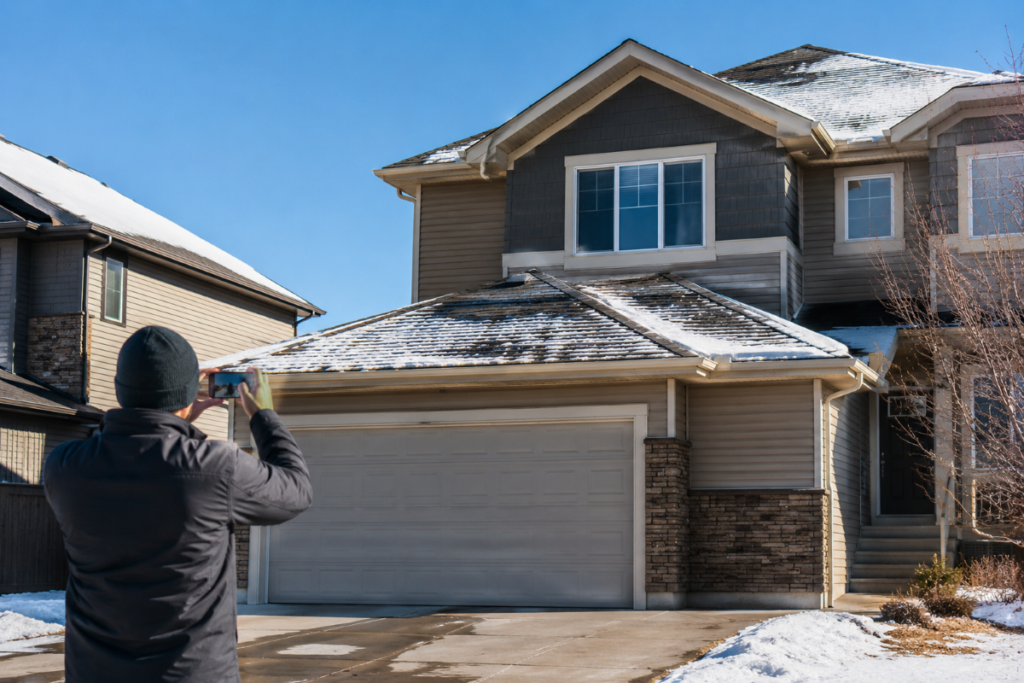
Hail claims are won and lost on evidence. The strongest file contains a written contractor report with the storm date, close-up photographs of bruised or fractured shingles with a reference marker for scale, wide shots establishing that damage is distributed across multiple roof slopes, photographs of soft-metal collateral damage on vents and eavestroughs, and granule accumulation at downspouts.
Distribution matters as much as severity. A few marks on one slope can be argued as wear or mechanical damage; consistent impacts across several slopes and multiple soft-metal surfaces establish a hail event. That is precisely what a proper inspection documents and a quick drive-by assessment does not.
Keep a written record of every conversation with your insurer: date, name, and what was said. If a commitment is made verbally, follow up with an email confirming it. Our guide to hail damage on asphalt shingle roofs shows what the damage actually looks like up close, so you know what should appear in your file.
If your claim is denied or underpaid
A denial or a low settlement is a position, not a verdict. Denials usually cite one of a few reasons: the damage was assessed as wear and tear rather than hail, the damage was judged cosmetic rather than functional, the reported date does not match the weather record, or the claim was filed too long after the event.
The response is the same in each case: answer with documentation. Request the adjuster’s report in writing and read the reasoning. Have your contractor prepare a rebuttal that addresses the stated reason directly — for example, showing that granule loss and mat fracture are functional damage that shortens the roof’s service life, not a cosmetic issue. Then request a formal reinspection in writing.
If that does not resolve it, most insurers have an internal complaints process, and Alberta homeowners can escalate to the General Insurance OmbudService or the Alberta Superintendent of Insurance. Many policies also include an appraisal clause, which allows an independent third party to settle a dispute over the amount without going to court.
One warning specific to Calgary: after every major storm, out-of-province crews arrive promising free roofs and offering to “cover your deductible.” Waiving or absorbing a deductible is insurance fraud, and those crews are usually gone before any warranty matters. Our guide on choosing a roofing contractor and avoiding storm-chaser scams covers how to spot them.
How long a hail claim takes in Calgary
In a normal season, a straightforward hail claim moves from first call to adjuster inspection within one to three weeks, with a settlement decision shortly after. Repairs are then scheduled around the roofing queue and the weather.
After a major storm, that timeline stretches considerably. When a single event generates tens of thousands of claims across the city, adjusters are booked out, materials tighten, and reputable roofing crews fill their calendars quickly. This is the practical reason to file early rather than wait to see how bad things are — position in the queue is decided by when you call.
Winter adds its own constraint. Asphalt shingles need reasonable temperatures to seal properly, so a claim approved in late fall may be scheduled for spring, with temporary protection installed in the meantime. That is normal and does not affect your coverage as long as the claim is opened and documented. If damage is causing active leaking, our emergency call-out service can secure the roof while the claim proceeds.
Why Calgary homeowners bring Total Exteriors into their hail claim

Total Exteriors is a Calgary exterior renovation and restoration company specializing in roofing, siding, eavestrough, and windows. We work through every hail season this city throws at us, which means we know what our storms do to a roof and what a complete, correct repair scope looks like — not a generic one.
We inspect and document thoroughly, produce reports written for adjusters, and attend the adjuster inspection with you so that questions get answered on the roof instead of in a phone queue weeks later. We do not chase storms, we do not promise free roofs, and we tell you plainly when damage does not warrant a claim. If you are starting a claim, our insurance claims support explains how we work alongside your insurer, and you can report a claim directly through our site.
Conclusion
A hail damage roof insurance claim rewards preparation more than persistence. Document the storm the day it happens, get an independent inspection before the adjuster is booked, understand whether your policy pays replacement cost or a depreciated amount, and review the settlement scope line by line instead of accepting it at face value. Calgary’s hail seasons are not getting gentler, and insurers have adjusted their terms accordingly — the homeowners who come through a claim whole are the ones who treat it as a documented process rather than a phone call. When you are unsure whether your roof took real damage, an honest inspection settles it in an afternoon.
Frequently Asked Questions
How long do I have to file a hail damage roof insurance claim in Alberta?
Most Alberta policies require you to report damage as soon as reasonably possible after you discover it, and many set a limitation period of about two years for legal action. In practice, file within days rather than months — long delays make it harder to prove the damage came from a specific storm.
Will filing a hail claim raise my insurance premium?
Hail is a weather event rather than a fault-based loss, so a single claim affects your premium differently than an at-fault claim would. That said, Alberta home insurance costs have risen across the board because of repeated severe hail, and individual insurers weigh claim history differently — your broker can tell you how your specific policy is affected.
How do I know if my roof has hail damage if I can’t see anything?
Most hail damage is invisible from the ground. Look for granules collecting at the bottom of downspouts, dents in eavestroughs, downspouts, vents, and air conditioner fins, and marks on window screens or siding. If the soft metals around your home are dented, the roof almost certainly took impacts too and should be professionally inspected.
Does insurance cover a full roof replacement for hail damage?
It can. When hail damage is widespread across multiple slopes, a full replacement is often the only correct repair, and insurers frequently approve it. Whether you receive the full cost or a depreciated amount depends on whether your policy values the roof at replacement cost or actual cash value.
Should I get a roof inspection before or after calling my insurance company?
Before. An independent inspection gives you documented evidence and a written scope of work going into the claim, rather than reacting to the adjuster’s assessment afterward. It also tells you whether the damage is significant enough to be worth filing against your deductible at all.
What if the insurance payout doesn’t cover the full cost of my new roof?
Compare the adjuster’s scope against your contractor’s report line by line — gaps are often missing items such as flashing, ridge cap, vents, or underlayment rather than a genuine disagreement about the damage. Submit those omissions as a written supplement and request a reinspection if needed.
Are Class 4 impact-resistant shingles worth it in Calgary?
For many Calgary homes they are, particularly when you are already replacing a hail-damaged roof. The Insurance Bureau of Canada recommends impact-resistant roofing for hail-prone areas and notes insurers offer savings of up to 50% for hail-resistant materials, though the discount and eligibility vary by insurer.