
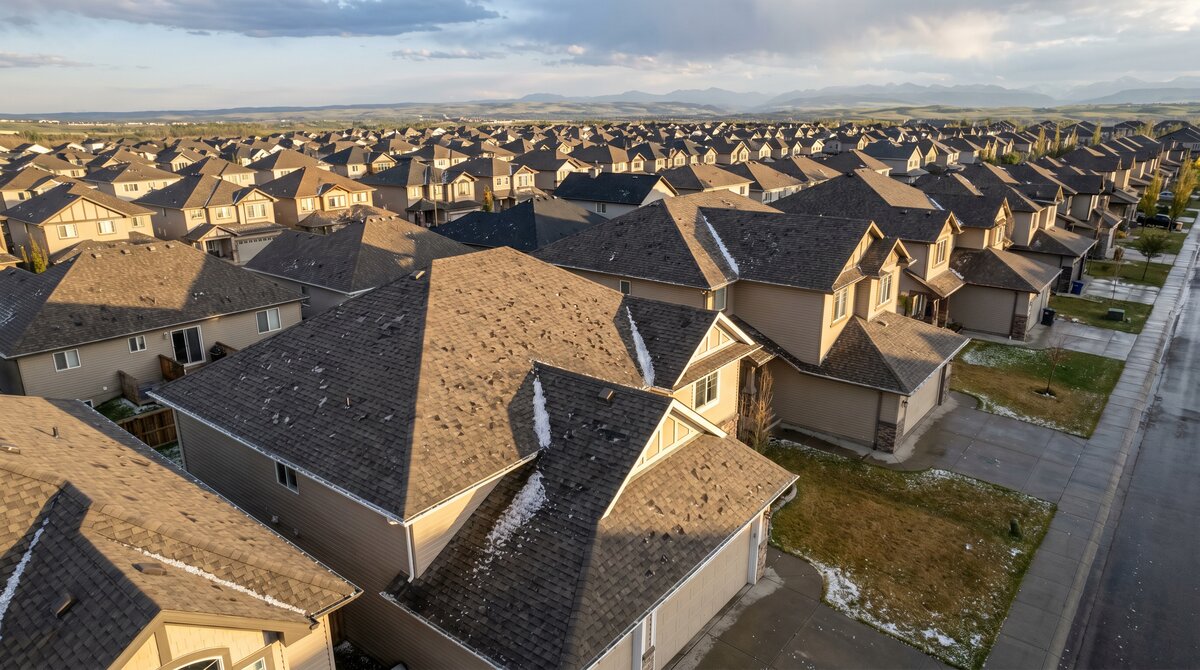
If a Calgary hailstorm just rolled through your neighbourhood, your asphalt shingle roof is almost certainly carrying damage you cannot see from the driveway. Calgary sits squarely inside Canada’s worst hail corridor — Environment Canada confirms the city ranks first nationally for hail loss, and most residential roofs here are asphalt three-tab or architectural shingles. This 2026 guide walks you through what hail damage to asphalt shingles in Calgary actually looks like, what to do in the first 48 hours, real repair costs, and how the insurance claim process works in Alberta.
Key Takeaways
- Hail 25 mm (1 inch) or larger reliably bruises and cracks asphalt shingles — even when no granules are visibly missing from the ground.
- Calgary’s hail belt averages 8 to 12 damaging events per season (mid-June through August), with the August 2024 storm causing about $3.25 billion in insured losses in the Calgary area.
- Insurance carriers in Alberta generally require a claim within 30 to 90 days of a hailstorm — document damage immediately with photos, the storm date, and a professional roof inspection.
- A typical residential hail-damage asphalt shingle repair in Calgary runs $450 to $1,800 for spot work, $9,500 to $22,000 for full replacement on an average 25-square home.
- Storm chasers flood Calgary after every major hail event — verify a roofer’s local address, WCB number, and manufacturer certification before signing anything.
Table of Contents
How Hail Damages Asphalt Shingles
Hail damage to asphalt shingles is a mechanical impact problem with three distinct failure modes. Understanding these helps you know what you are looking at on your own roof.
Granule loss is the most common form. The coloured ceramic granules on the surface of every asphalt shingle are not just cosmetic — they shield the asphalt mat underneath from UV radiation. When hail strikes, granules dislodge in a pattern called a “bruise.” Once exposed, the asphalt mat starts ageing in months instead of decades, and shingle life can drop by 60 to 80 percent.
Bruising (also called soft spots) happens when impact compresses and fractures the fibreglass mat inside the shingle without breaking the surface visibly. You feel it as a soft, slightly indented circle when you press the area with your thumb. Bruised shingles fail prematurely — usually within 18 to 36 months — as freeze-thaw cycles widen the internal fracture.
Cracking and puncture show up on hail stones 30 mm and larger, or when shingles are older than 12 to 15 years and have lost flexibility. These produce visible fissures or holes that the homeowner can sometimes spot from the ground with binoculars.
The Insurance Bureau of Canada confirms that hail 25 mm or larger — about the size of a quarter — is the threshold at which insurers generally consider asphalt shingle damage “reasonably certain” rather than cosmetic. Calgary’s June through August storms regularly produce hail well above this size; the August 2024 storm produced golf-ball to baseball-sized hail across much of north Calgary.
What to Do in the First 48 Hours After a Calgary Hailstorm
The first 48 hours after a hailstorm matter more than most homeowners realize. Insurance carriers and roofers both use this window to establish damage causation and date the claim. Here is the order of operations that protects your claim and your roof.
1. Document the storm event itself. Note the date, time, and approximate hail size (a coin, golf ball, ping pong ball comparison works). Environment Canada publishes storm reports at canada.ca that can serve as third-party confirmation.
2. Photograph from the ground. Walk the perimeter of your house. Photograph dents in metal trim, downspouts, exhaust caps, and especially the colour of the gutter line — fresh granule loss from your roof tends to collect in eavestroughs and at the bottom of downspouts as a dark, sandy grit.
3. Do not climb the roof. Wet, hail-pelted shingles are slippery, and walking on bruised shingles compounds the damage. Calgary roofers carry the insurance to do this work safely.
4. Book a professional inspection within 7 days. A qualified roofer will perform a test square (10′ x 10′ chalk-grid count of impact marks per slope), photograph soft spots, and produce a written damage report. This is the document your insurance adjuster will rely on.
5. Watch for canvassers, but verify before signing. Storm chasers — out-of-province roofing crews that follow hail events — flood Calgary after every major storm. They often pressure homeowners to sign assignment-of-benefits paperwork on the spot. Verified local Calgary hail damage roofers have permanent local addresses, Alberta WCB coverage, and manufacturer-issued certifications that storm chasers cannot match.
| Action | Timing | Why It Matters |
|---|---|---|
| Document storm date and hail size | Same day | Anchors the insurance claim to a specific event |
| Photograph ground-level damage | Within 24 hours | Establishes visible collateral evidence |
| Book professional roof inspection | Within 7 days | Produces the written report adjusters require |
| Notify insurance carrier | Within 30 days | Most Alberta policies require prompt notice |
| Sign repair contract | After adjuster visit | Avoids storm-chaser assignment-of-benefits traps |
Spotting Hail Damage From the Ground
You can identify likely hail damage on an asphalt shingle roof from your front yard if you know what to look for. A pair of 10x binoculars helps — never climb the roof yourself.
Granules in the gutter. Walk the eavestrough line and look for dark grit collected in low spots and at the downspout outlet. Fresh granule loss looks like coarse sand, dark brown or black depending on shingle colour. A few teaspoons after a storm is suspicious; a cup or more is strong evidence of widespread damage.
Dents on metal accessories. Roof vents, the metal cap on your chimney, plumbing stack flashing, and aluminum siding all dent under hail impact. If you can see fresh dimples in these surfaces, the asphalt shingles beside them almost certainly took the same hits.
Damage to soft items. Look at deck furniture, vinyl shed roofs, and the screens on basement windows. Pinholes in screens, splits in vinyl, and dents in metal patio chairs all confirm hail size and impact angle.
Shingle inconsistencies you can see from the ground. With binoculars, scan each slope for shingles that look “spotted” or have a different sheen than their neighbours. A bruised shingle often looks slightly darker because granules around the impact have been knocked away, exposing the black asphalt mat underneath.
Skylights, vents, and ridge caps. These are the most exposed roof components. Cracks, broken glass, or visibly damaged ridge cap shingles are clear evidence of severe hail.
Hidden Hail Damage Only a Roofer Can Find
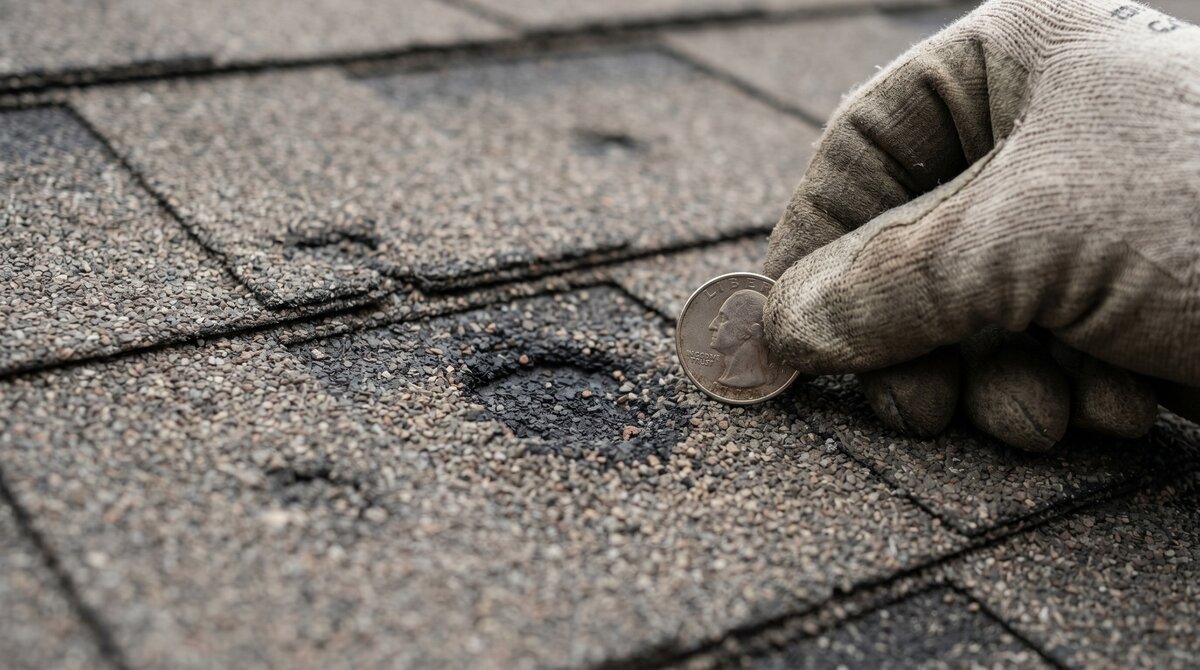
Most hail damage to asphalt shingles is invisible from the ground. A professional roofer with hail-damage training will find the rest by walking the roof systematically.
Test squares. The industry standard for documenting hail damage is the 10-foot by 10-foot test square. A roofer chalks a square on each slope (north, south, east, west) and counts the number of impact marks within. Adjusters generally consider 8 or more impacts per square as “functional damage” — meaning the slope qualifies for replacement, not just spot repair.
Soft-spot palpation. Bruised shingles feel different from intact shingles. A trained roofer presses suspicious areas with their thumb. A bruise gives like a soft apple under the skin — that compression confirms a fractured mat underneath.
Mat exposure mapping. Where multiple granules have been displaced, the asphalt mat is visible. Mat exposure under 10 mm in diameter is typically still functional; larger exposed areas accelerate failure and require replacement.
Sealant strip damage. Asphalt shingles bond to the shingle below via a heat-activated sealant strip. Hail can crack this seal even when the surface looks intact. A roofer tests bond integrity by lifting tabs gently; tabs that lift without resistance have failed seals and will blow off in the next Calgary wind event.
Underlayment and decking checks. If hail has punctured shingles, the felt or synthetic underlayment beneath is the next defence. From the attic side, a roofer or restoration specialist can see daylight or moisture stains that confirm penetration — and these usually mean the decking needs partial replacement too.
Hail Damage Repair Cost in Calgary (2026 Numbers)
Hail damage repair costs in Calgary span a wide range depending on the scope of damage, shingle grade, roof complexity, and current material pricing. Here is what the 2026 market looks like for an average detached home with a 25-square (2,500 sq ft) asphalt shingle roof.
Spot repair (1 to 3 slopes affected, no full tear-off): $450 to $1,800. This covers replacement of individual damaged shingles and bundles where granule loss is concentrated. Spot repair is appropriate when impact count per test square is below the carrier’s threshold and the rest of the roof has more than 10 years of life remaining.
Partial replacement (one or two slopes): $3,200 to $8,500. Used when one slope (typically the south or west, which catch the most hail) fails inspection but the other slopes pass. Colour matching can be a challenge on older roofs because shingle manufacturers update their colour lines every few years.
Full replacement, three-tab shingles: $9,500 to $14,500. Three-tab shingles are the most affordable option but carry only a 20 to 25 year manufacturer warranty and lower impact resistance. Many Calgary insurance carriers now incentivize impact-rated upgrades.
Full replacement, architectural (laminated) shingles: $13,500 to $19,000. Architectural shingles are the Calgary standard — 30 to 40 year warranty, better wind resistance, more visual depth. Most insurance settlements in Calgary now default to architectural replacement.
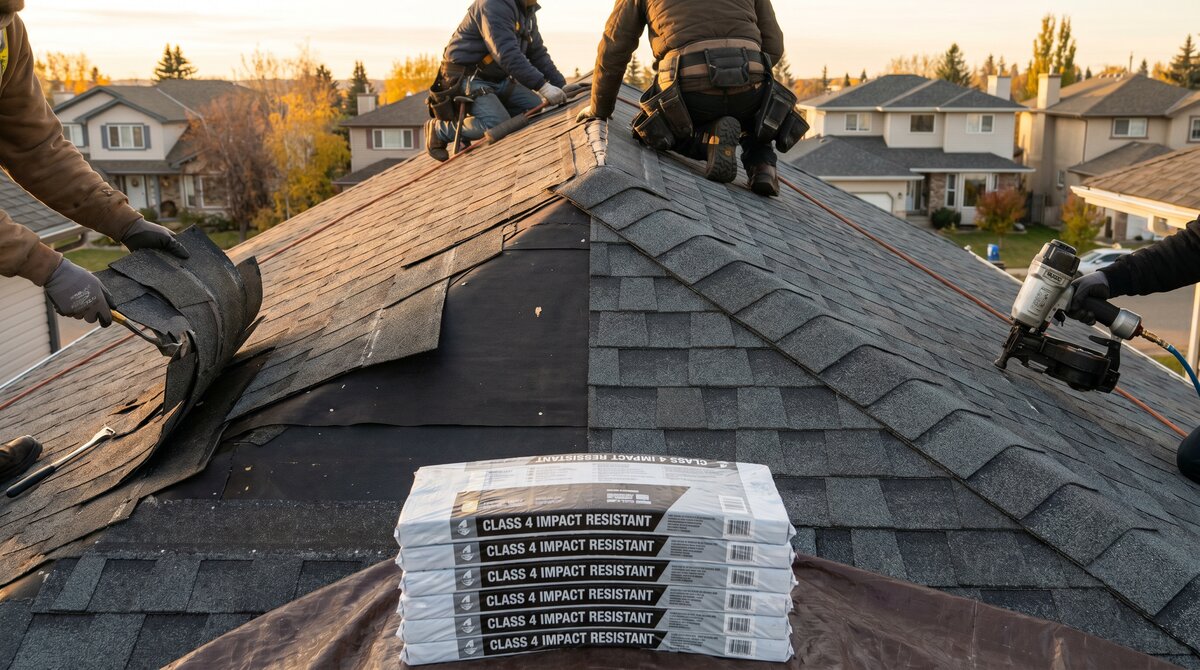
Full replacement, Class 4 impact-resistant shingles: $16,000 to $22,000. Class 4 (IR) shingles are tested for resistance to 2-inch steel-ball impact and qualify for substantial Alberta home insurance discounts — typically 15 to 35 percent off the roof portion of premium, every year. Over a 25-year roof life, the discount usually exceeds the upgrade cost.
These figures include tear-off, new underlayment, drip edge, ice and water shield on eaves and valleys, ventilation upgrades where code requires, disposal, and labour at current Alberta tradesperson rates. Steep slopes (above 8/12 pitch), multiple stories, complex valley work, and skylight resets add 10 to 25 percent.
Filing a Hail Damage Insurance Claim in Alberta
Alberta homeowner insurance policies generally cover hail damage to roofs under “wind, hail, and storm” perils. The claim process is straightforward when you follow it in order, but homeowners lose payouts every year by skipping documentation or signing storm-chaser paperwork before the adjuster confirms scope.
Step 1: Confirm coverage. Read your policy declarations page or call your broker. Most Alberta policies cover hail damage on a replacement-cost basis subject to a deductible — usually $1,000 to $2,500. Some policies have a separate, higher hail-and-wind deductible (often 1 to 2 percent of the dwelling limit) which can be $5,000 or more on a $500,000 home.
Step 2: Open the claim. Call your insurance carrier’s claims line, not your broker, to log the claim. You will receive a claim number and an adjuster assignment within 1 to 3 business days. Reference the storm date — having Environment Canada storm reports ready helps.
Step 3: Independent roof inspection. Before the adjuster visits, have a qualified Calgary roofer perform their own inspection and produce a written damage report with test square photos and an itemized scope. This document keeps the adjuster’s scope honest.
Step 4: Adjuster visit. The adjuster will visit your home, walk the roof (or have a third-party inspector do so), and produce a scope-of-loss document. Your roofer can attend this inspection — and should — because adjuster scopes often under-count slopes and underlayment requirements.
Step 5: Estimate review and supplements. The carrier issues an Actual Cash Value (ACV) cheque first, holding back the depreciation (Recoverable Depreciation, or RD) until the work is complete. Once the roof is replaced, the roofer submits a Certificate of Completion and the RD is released. Any line items missing from the adjuster’s scope — drip edge, code-required ventilation, double-layer tear-off — can be submitted as a supplement.
The Alberta government’s insurance consumer resources explain your right to dispute scope and use the General Insurance OmbudService (GIO) if you reach an impasse with your carrier.
You can also link this claim into your broader Calgary winter inspection if other components — fascia, eavestrough, soffit — sustained damage. Our guide on winter roof and exterior emergencies walks through the rest of the envelope, and the Total Exteriors residential roofing service page covers what a hail-driven replacement involves on a Calgary home.
Why Total Exteriors Is the Right Calgary Hail Damage Roofer
Total Exteriors has been working on Calgary roofs and exteriors for over two decades. We are not storm chasers — our office, warehouse, and crew all operate out of Calgary year-round, and most of our work comes from Calgary homeowner referrals.
Our hail damage practice covers the full claim lifecycle. We perform free roof inspections, document damage with test squares and adjuster-ready reports, attend the carrier’s inspection alongside your adjuster, and handle supplement filings when the scope misses items. We are certified installers for the major Canadian shingle manufacturers, which means our work carries the full manufacturer warranty — something many storm-chaser installations lose by skipping certified-installer requirements.
We also specialize in Class 4 impact-resistant shingle upgrades, which qualify Alberta homeowners for permanent insurance premium discounts. Our crews carry Alberta WCB coverage, full liability insurance, and we handle the disposal, code compliance, and permit work end-to-end. Emergency response — for active leaks or wind-blown shingles in the days after a storm — is available through our emergency call-out service.
Book your free Calgary hail damage roof inspection.
Same-week appointments. Insurance-ready documentation. No charge unless you choose us for the repair.
Conclusion
Hail damage to asphalt shingles in Calgary is rarely cosmetic. Granule loss, bruising, and sealant-strip failure cut decades off a roof’s lifespan and only get worse with each freeze-thaw cycle. The right move after a Calgary hailstorm is to document the event immediately, photograph ground-level damage, get a professional inspection within a week, and notify your insurance carrier before the 30-day claim window starts to close. Verifying that the roofer you hire is a local, certified, WCB-covered Calgary contractor protects both your warranty and your insurance claim from the storm chasers who flood the city after every major event.
Frequently Asked Questions
What size hail damages asphalt shingles?
Hail 25 mm (1 inch) or larger — roughly the size of a quarter — is the threshold at which asphalt shingle damage becomes reasonably certain. Smaller hail can still cause granule loss on older or weathered shingles, but insurance carriers in Alberta generally consider 25 mm the functional-damage threshold for newer roofs.
What does hail damage on asphalt shingles look like?
Hail damage appears as circular bruises with displaced granules, exposing the dark asphalt mat underneath. Each impact is typically 5 to 25 mm wide. The shingle may also feel soft when pressed because the fibreglass mat inside has fractured. Severe damage produces visible cracks or punctures.
How long do I have to file a hail damage claim in Alberta?
Most Alberta home insurance policies require prompt notice of loss — generally 30 to 90 days from the storm date — though policy language varies. Filing within the first 30 days protects your claim, gives the adjuster fresh evidence to work with, and prevents secondary damage from becoming a coverage dispute.
Will insurance cover the full cost of a hail-damaged roof replacement?
Most Alberta replacement-cost policies cover the full replacement minus your deductible, paid in two parts: the Actual Cash Value upfront and the Recoverable Depreciation after the work is done. You will pay the deductible (often $1,000 to $2,500, sometimes a percentage of the dwelling limit) and any chosen upgrades beyond the policy scope.
Are Class 4 impact-resistant shingles worth the extra cost in Calgary?
In Calgary, yes for most homeowners. Class 4 shingles cost roughly $2,500 to $4,000 more than architectural shingles on a typical 25-square home but qualify for permanent Alberta home insurance discounts of 15 to 35 percent on the roof portion of premium. Over a 25-year roof life, the cumulative discount usually exceeds the upgrade cost.
How do I avoid storm chasers after a Calgary hailstorm?
Verify three things before signing any roofing contract: a permanent Calgary or southern Alberta office address (not a hotel or trailer), an active Alberta WCB account number, and manufacturer-issued installer certification for the shingle brand they propose. Storm chasers typically fail all three checks and disappear when warranty issues arise.