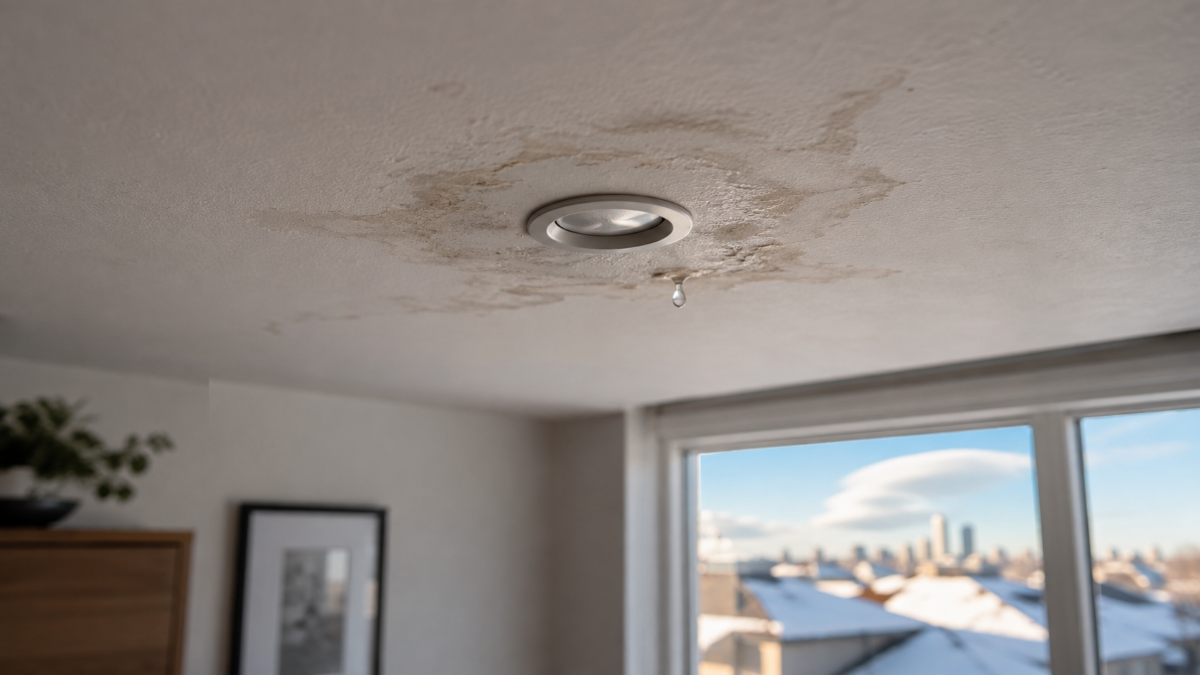
It happens on the mildest day of the month. The temperature swings twenty degrees overnight, and suddenly there is water dripping from a ceiling light, a stain spreading across a bedroom ceiling, or a damp patch around the bathroom fan. You call a roofer expecting to hear about a failed shingle — and the roof is fine. What you are dealing with is attic rain in Calgary, and it is not a roof leak at all. It is weeks of accumulated frost inside your attic melting all at once when a chinook rolls through. This guide explains what causes it, how to tell it apart from a genuine leak, why insulation alone rarely fixes it, and what actually stops it from happening again next winter.
Table of Contents
Key Takeaways
- Attic rain is condensation, not a roof leak — warm indoor moisture freezes on the underside of the roof deck, then melts during a warm spell.
- Calgary’s chinooks make it uniquely common here, because rapid thaws release weeks of accumulated frost in a single day.
- It has three causes working together: moist indoor air, air leaks into the attic, and inadequate roof ventilation.
- Adding insulation alone often makes it worse — sealing air leaks and restoring intake and exhaust ventilation is what actually solves it.
- Indoor humidity needs to drop as outdoor temperatures fall: roughly 30% at −10°C and 20% or lower at −30°C.
Attic rain: the quick answer
Attic rain in Calgary is condensation that forms when warm, humid indoor air escapes into a cold attic, freezes as frost on the underside of the roof sheathing, and then melts when temperatures rise — dripping down through insulation and ceilings as if the roof were leaking. It is caused by a combination of high indoor humidity, air leakage from the living space into the attic, and insufficient attic ventilation. The fix is to reduce indoor humidity, seal the air leaks, and restore proper intake and exhaust airflow through the attic.
The tell is the timing. A roof leak appears during rain or snowmelt on the roof surface. Attic rain appears during a thaw — often on a clear, sunny, unseasonably warm day when no precipitation has fallen at all.
What attic rain actually is
Every home generates moisture. Showers, cooking, laundry, dishwashers, houseplants, humidifiers, and simply breathing all release water vapour into the air. In a Calgary winter, that warm and comparatively humid indoor air wants to rise and escape — and the attic is directly above it.
When that air finds a gap into the attic, it meets the underside of the roof sheathing, which in January might sit at −25°C. The vapour does not have to cool gradually to condense; it freezes on contact, forming a layer of frost across the plywood, the nail tips, and any exposed metal. Over weeks of cold weather, that frost builds into a substantial sheet of ice.
Nothing appears to be wrong during that entire period. The problem only reveals itself when the attic warms above freezing and the accumulated frost melts all at once, soaking the insulation, running along ceiling joists, and finding its way through drywall, light fixtures, and bathroom fan housings. Homeowners experience it as a sudden, dramatic leak — which is why it is so often misdiagnosed.
Why Calgary chinooks trigger it
Attic rain occurs across cold-climate Canada, but Calgary is close to a worst-case scenario for it, and the reason is the chinook. A chinook can lift temperatures from −25°C to well above freezing within hours, several times each winter. That is exactly the condition that turns invisible frost into visible water.
In a climate with a steady, gradual thaw, accumulated attic frost sublimates and vents away slowly. In Calgary, the swing is fast and repeated: freeze, accumulate, thaw hard, refreeze. Each cycle deposits meltwater into your insulation, and each refreeze traps it there. This is the same freeze-thaw punishment that works on the outside of your home too — our chinook damage inspection guide covers what those cycles do to shingles, flashing, and sealants.
Newer and recently renovated homes are often hit hardest, which surprises people. Tighter, better-insulated construction holds indoor moisture in far more effectively than a draughty older house did — so unless ventilation and mechanical air exchange are working properly, humidity climbs and looks for the nearest cold surface.
Where the moisture comes from
Attic rain needs three ingredients at once: moisture in the indoor air, a path for that air to reach the attic, and an attic that cannot flush the moisture back outside. Remove any one of them and the problem largely disappears.
The moisture sources are usually mundane. Furnace humidifiers left at a summer setting are among the most common culprits in Calgary homes. Bathroom and kitchen exhaust fans that terminate inside the attic — or connect to a vent hood through a loose, uninsulated duct — pump warm wet air directly into the cold space. Long showers without running the fan, unvented dryers, and a basement without a vapour barrier all contribute.
The air paths are equally ordinary: the attic hatch, recessed light housings, plumbing and electrical penetrations, the gap around the chimney or furnace flue, top plates of interior walls, and bathroom fan housings that were never sealed to the ceiling. Each one is small. Collectively, in a typical home, they add up to the equivalent of leaving a window open.
| Outdoor temperature | Target indoor humidity | What to do |
|---|---|---|
| Above −5°C | 35–40% | Normal operation; run exhaust fans |
| −10°C | About 30% | Turn the humidifier down a setting |
| −20°C | About 25% | Watch for window condensation as a warning |
| −30°C or colder | 20% or lower | Shut the humidifier off entirely |
A simple hygrometer costing a few dollars will tell you where you stand. A useful rule of thumb: if condensation is forming on the inside of your windows during a cold snap, your indoor humidity is too high for the weather, and your attic is collecting frost.
Signs of attic rain vs. a real roof leak
Distinguishing the two matters, because the repairs are completely different — and replacing shingles will do nothing for attic rain.
| Clue | Attic rain | Roof leak |
|---|---|---|
| When it appears | During a warm spell or chinook | During or right after rain or snowmelt |
| Where it shows | Multiple spots, often near fans and lights | One consistent location every time |
| Season | Winter and early spring only | Any time of year |
| In the attic | Widespread frost or damp sheathing | Localized staining traced to one entry point |
| Other symptoms | Window condensation, musty smell, damp insulation | Damaged shingles or failed flashing above the stain |
The definitive check is to look in the attic during a cold snap, before the thaw. If the underside of the sheathing is covered in frost or the nail tips are furry with ice, you have your answer. If it is dry and there is staining traced to a specific penetration, you have a roof leak — and our guide to winter roof and exterior emergencies covers what to do next.
How to fix attic rain for good

The permanent fix works on all three ingredients in order. Doing one without the others is why so many homeowners deal with this twice.
1. Bring indoor humidity down
Turn the furnace humidifier down or off during cold snaps, run bathroom fans for at least twenty minutes after showers, use the range hood when cooking, confirm the dryer vents outside, and if the home has an HRV, make sure it is running rather than switched off for the winter. This is the fastest change and costs nothing.
2. Seal the air leaks into the attic
This is the step that actually stops the moisture from reaching the cold sheathing. Weatherstrip and insulate the attic hatch, seal around plumbing stacks, wiring penetrations, and top plates, gasket or replace non-sealed pot lights, and seal bathroom fan housings to the ceiling. Confirm every exhaust fan duct is insulated, sealed at the joints, and terminates through a proper exterior vent — not simply pointed toward the soffit.
3. Restore proper attic ventilation
Ventilation removes the moisture that inevitably still gets in. It requires balanced airflow: cool dry air entering low at the soffits and moist air exhausting high at the ridge or roof vents. This is where most attic rain problems are ultimately solved — and most often overlooked.
Roof ventilation: the half of the fix that gets skipped
Search attic rain and you will mostly find insulation companies. Insulation matters, but insulation alone does not vent moisture — and blown-in insulation installed carelessly is one of the most common causes of the problem in Calgary homes, because it buries the soffit intake vents.
An attic needs air moving through it. The building code baseline is roughly one square foot of net free vent area for every 300 square feet of insulated ceiling, with that area split between low intake and high exhaust so air actually circulates rather than stagnating. Low-slope roofs generally require double that ratio.
In practice, the failures we find are consistent: soffit vents packed solid with insulation, painted-over or debris-blocked perforated soffit panels, missing baffles at the eaves, exhaust vents installed without matching intake, and mixed vent types that short-circuit airflow so the roof pulls air from the nearest vent instead of drawing it up from the soffits. Any one of these turns a properly sized ventilation system into a sealed box.
Because intake happens at the eaves, attic ventilation and your soffit, fascia, and eavestrough system are one system, not two. When we assess attic rain, we check intake at the soffits, exhaust at the roof, baffle placement, and the roof deck condition together — because fixing one without the others rarely holds.
What it costs you if you ignore it
Attic rain is not cosmetic. Wet insulation loses most of its R-value, so heating costs rise through exactly the season you can least afford it. Repeated soaking of the roof sheathing leads to delamination and rot, which eventually means replacing plywood during a roof replacement rather than just shingles.
Persistent moisture also creates conditions for mould in the attic and in ceiling cavities, and repeated staining ruins drywall and paint. There is an insurance dimension too: because attic rain develops gradually from a maintenance issue rather than a sudden accidental event, many policies treat it very differently from storm damage — another reason to correct it early rather than claim it later.
The good news is that it is entirely preventable, and the diagnosis is straightforward for anyone who knows what to look for. Winter is also when a range of related problems surface at once, which our guide on how Calgary winters damage your home exterior walks through.
Why Calgary homeowners call Total Exteriors about attic rain

Total Exteriors is a Calgary exterior renovation and restoration company working across roofing, siding, eavestrough, soffit, and windows. Because we work on both the roof and the eaves, we look at attic rain as a whole-system problem — intake, exhaust, deck condition, and roof envelope — rather than treating it as an insulation sale.
We inspect the attic and the roof together, tell you plainly whether you are dealing with condensation or an actual leak, and fix the ventilation and roof-side causes properly. If the roof deck has already been damaged by repeated freeze-thaw cycles, we will show you the evidence and explain your options honestly. You can see the full scope of our residential roofing services, and if you are heading into winter, our guide to maintaining your home’s exterior through a Calgary winter is a good place to start.
Conclusion
Attic rain in Calgary is a moisture problem wearing a roof leak’s costume. Warm, humid indoor air escapes into a freezing attic, builds up as frost through weeks of cold, and arrives in your ceiling the moment a chinook pushes temperatures above zero. Fixing it means lowering indoor humidity, sealing the air paths into the attic, and restoring balanced intake and exhaust ventilation — in that order. Insulation alone will not do it, and neither will new shingles. Check your attic during the next cold snap: if the sheathing is white with frost, you have found your leak before it finds your ceiling.
Frequently Asked Questions
What causes attic rain in Calgary homes?
Warm, humid air from inside the home escapes into the cold attic through gaps such as the attic hatch, pot lights, and unsealed fan housings, then freezes as frost on the underside of the roof sheathing. When a chinook or warm spell arrives, that frost melts and drips through the insulation and ceiling.
Is attic rain a roof leak?
No. A roof leak lets outside water in through damaged shingles, flashing, or penetrations, and it appears during rain or snowmelt. Attic rain is condensation generated inside the home, and it appears during a thaw — often on a dry, sunny day. The repairs required are completely different.
Does adding more attic insulation fix attic rain?
Usually not on its own, and it sometimes makes things worse if the new insulation blocks the soffit intake vents. Insulation slows heat loss but does nothing to stop humid air leaking into the attic or to vent the moisture back outside. Air sealing and balanced ventilation are what solve it.
What should my indoor humidity be during a Calgary winter?
Roughly 35–40% in mild weather, dropping to about 30% at −10°C, 25% at −20°C, and 20% or lower below −30°C. If condensation is forming on the inside of your windows during a cold snap, your humidity is too high for the conditions.
Will home insurance cover attic rain damage?
Often not, because attic rain develops gradually from a maintenance and ventilation issue rather than a sudden accidental event, and most policies exclude that. Coverage depends entirely on your policy wording, so check with your broker — and treat prevention as the more reliable strategy.
How do I check my attic for attic rain?
Look during a cold stretch, before any thaw. Open the hatch and shine a light on the underside of the roof sheathing and the nail tips: widespread frost, ice crystals, or damp, matted insulation confirm it. Do not walk on the ceiling joists if you are unsure — a professional inspection is safer and more thorough.
Why do newer Calgary homes get attic rain more often?
Newer homes are built much tighter, so indoor moisture that once escaped through draughts now stays inside and builds up. Unless mechanical ventilation such as an HRV is running and the attic has proper intake and exhaust, that trapped humidity finds the coldest surface available — the roof deck.