
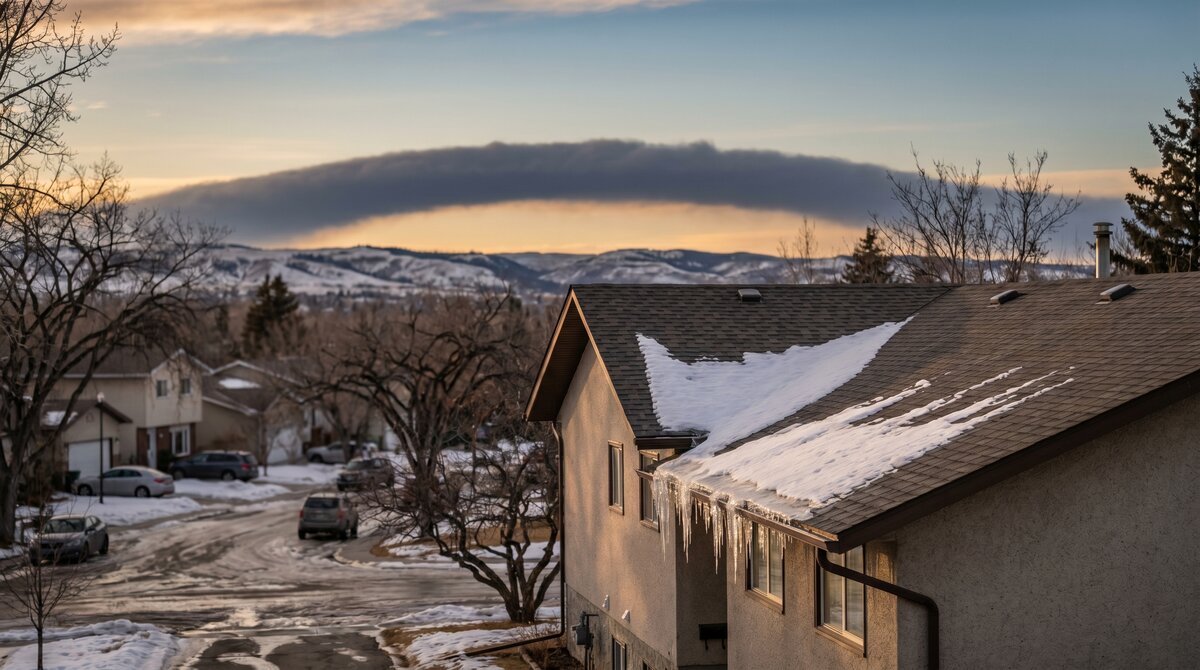
Chinook winds are a defining feature of Calgary winters — and a uniquely punishing force on roofs. A single chinook can swing the outdoor temperature 25 to 30 degrees Celsius in under 24 hours, then reverse the cycle within days. No roofing system anywhere else in Canada faces the same volume of freeze-thaw stress, and the cumulative damage to asphalt shingles, sealants, flashing, and ridge caps is one of the most under-discussed reasons Calgary roofs fail earlier than their warranty suggests. This 2026 guide walks through what chinook damage to Calgary roofs looks like, how to inspect for it after winter, and what repairs prevent small problems from becoming leak emergencies.
Key Takeaways
- Calgary averages 30 to 35 chinook days per winter, each producing a freeze-thaw cycle that mechanically stresses every sealed joint on an asphalt shingle roof.
- Sealant strips, ridge cap adhesives, pipe stack boots, and flashing caulking are the first chinook-damage casualties — they typically fail 5 to 8 years earlier in Calgary than in non-chinook climates.
- The right time to inspect for chinook damage is mid-April through early June, after the last hard freeze but before summer hailstorms and wildfire smoke obscure new issues.
- Most chinook-related repairs are small (sealant refresh, flashing reset, ridge cap replacement) — typically $200 to $1,200 — when caught early.
- Ignored chinook damage compounds: a $300 sealant repair this spring prevents the $3,000-plus interior-leak callouts every Calgary roofer answers in October.
Table of Contents
What Chinook Damage to a Calgary Roof Actually Means
Chinook damage is not a single failure event — it is the cumulative mechanical fatigue caused by repeated, rapid freeze-thaw cycles on every sealed and laminated component of an asphalt shingle roof. Calgary’s chinooks routinely swing outdoor air temperatures from -25 degrees C to +10 degrees C and back within 48 hours. Each cycle moves materials slightly: asphalt shingles expand and contract, water trapped in micro-cracks freezes and pushes joints open, sealants harden and shrink, and the metal flashing along chimneys and skylights flexes against rigid wood structure.
Calgary winters typically produce 30 to 35 chinook days per season according to the long-term weather records summarized on Environment Canada’s chinook page. Over a 25-year roof lifespan, that is roughly 800 freeze-thaw cycles — far more than any other Canadian city. The result is that Calgary roofs reliably show sealant failure, ridge cap lift, and flashing leakage 5 to 8 years before their manufacturer warranty period ends, even when the shingle field itself looks healthy.
Importantly, chinook damage is rarely visible from the ground. Unlike hail damage, which leaves visible dents and granule loss, chinook damage is the slow opening of joints and seals that you only notice when water gets through.
Roof Components Most Affected by Chinook Cycles
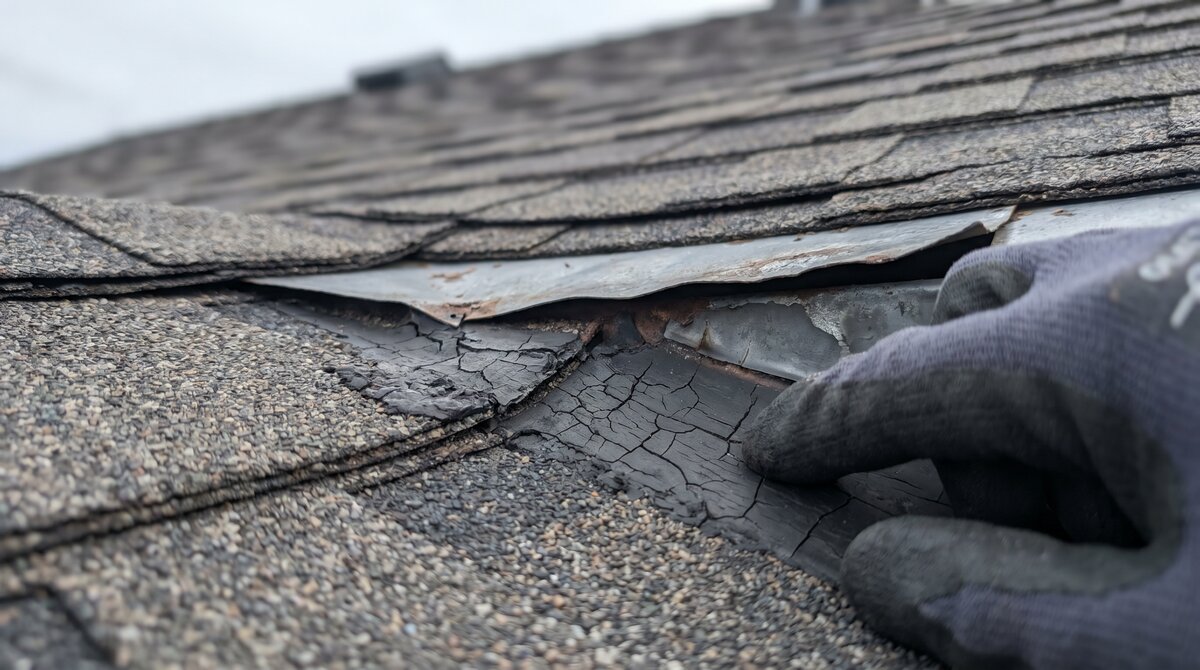
Not every part of an asphalt shingle roof is equally affected by chinook freeze-thaw cycles. The damage clusters in specific components.
Sealant strips. Every asphalt shingle bonds to the shingle below via a heat-activated sealant strip. Chinooks soften and re-set this sealant in cycles that the manufacturer never tested for. After 8 to 12 winters in Calgary, sealant strips on south- and west-facing slopes — which catch the most chinook sun — start losing bond. Tabs lift in wind events, and rainwater finds its way under the shingle.
Ridge cap shingles. Ridge caps sit at the peak where the most thermal swing occurs. They are typically the first shingles to crack, lift, or lose granules from chinook fatigue. Walking the roof in spring, a roofer will find ridge cap edges curled or split where the surrounding shingles look fine.
Pipe stack and vent boots. The rubber or thermoplastic boot that seals the plumbing vent pipe to the roof is one of the shortest-lived roof components in Calgary. Chinook thermal cycling cracks these boots, often within 8 to 10 years. The result is one of the most common Calgary roof leak sources — water tracking down the pipe into the attic.
Flashing caulk and step flashing. Chimneys, skylights, and any sidewall-to-roof junction use a combination of metal flashing and sealant caulk. The caulk component shrinks and cracks under chinook cycling; the flashing edges lift as the wood structure beneath moves with humidity. Re-caulking and resetting flashing is one of the most common spring repairs in Calgary.
Drip edge and gable trim. The metal drip edge along the roof perimeter expands and contracts at a different rate than the wood deck. Over time, fastener heads back out, the metal edge loosens, and water gets behind it during heavy rain. Calgary roofs older than 15 years almost universally need drip-edge re-securing.
Underlayment at penetrations. Felt or synthetic underlayment around skylights, vents, and chimneys takes repeated thermal stress where it meets metal. Tears at these spots are invisible from outside but are a primary cause of ceiling stains in older Calgary homes.
Chinook Damage Warning Signs to Check This Spring
You can check for many chinook damage warning signs from the ground before booking a professional inspection. A pair of binoculars and a careful walk around the house is enough for first-pass detection.
Lifted shingles or visible tab edges. Look at each roof slope, especially the south and west faces. Shingles should lie flat against each other in continuous courses. Any visible edge sticking up, especially along the bottom edge of a shingle, is failed sealant strip and needs attention.
Cracked or curled ridge caps. The ridge of the roof should look like a single clean line of overlapping caps. Curling at the corners, splits across the cap, or missing granules concentrated on the ridge are all chinook-damage signatures.
Granules in the gutters out of season. Hail produces a sudden flood of granules. Chinook fatigue produces a slow, steady trickle. If you find a coffee-can worth of granule grit at the bottom of downspouts after spring runoff — and no hail has hit — that is chinook-driven granule loss from ageing sealant edges and curling tabs.
Stains on ceilings or attic sheathing. Walk through every room with a flashlight and look at the ceiling, especially under bathrooms (plumbing vent leaks) and under skylights or chimneys (flashing failures). In the attic, check the underside of the roof deck for water streaks, mineral deposits, or active dampness.
Failed or missing pipe boot collar. From the ground with binoculars, scan each plumbing vent on the roof. The black rubber or grey thermoplastic collar should be smooth and intact. If it looks cracked, curled, or has fallen away from the pipe, you have an active leak source the next time it rains.
Visible separation at chimney or skylight edges. Look at where any vertical structure meets the roof. The sealant line should be uniform and continuous. Gaps, cracks, or daylight visible through the joint are immediate repair priorities.
| Chinook Damage Sign | Where to Look | Repair Urgency |
|---|---|---|
| Lifted shingle tabs | South and west slopes, lower courses | Within 30 days |
| Cracked ridge cap | Ridge line, full length | Before next major windstorm |
| Failed pipe boot | Bathroom plumbing vents | Immediate |
| Flashing sealant cracks | Chimney, skylight, sidewalls | Within 60 days |
| Loose drip edge | Roof perimeter | Within season |
| Ceiling stain or attic damp | Interior, under penetrations | Immediate |
The Post-Chinook Spring Roof Inspection Process
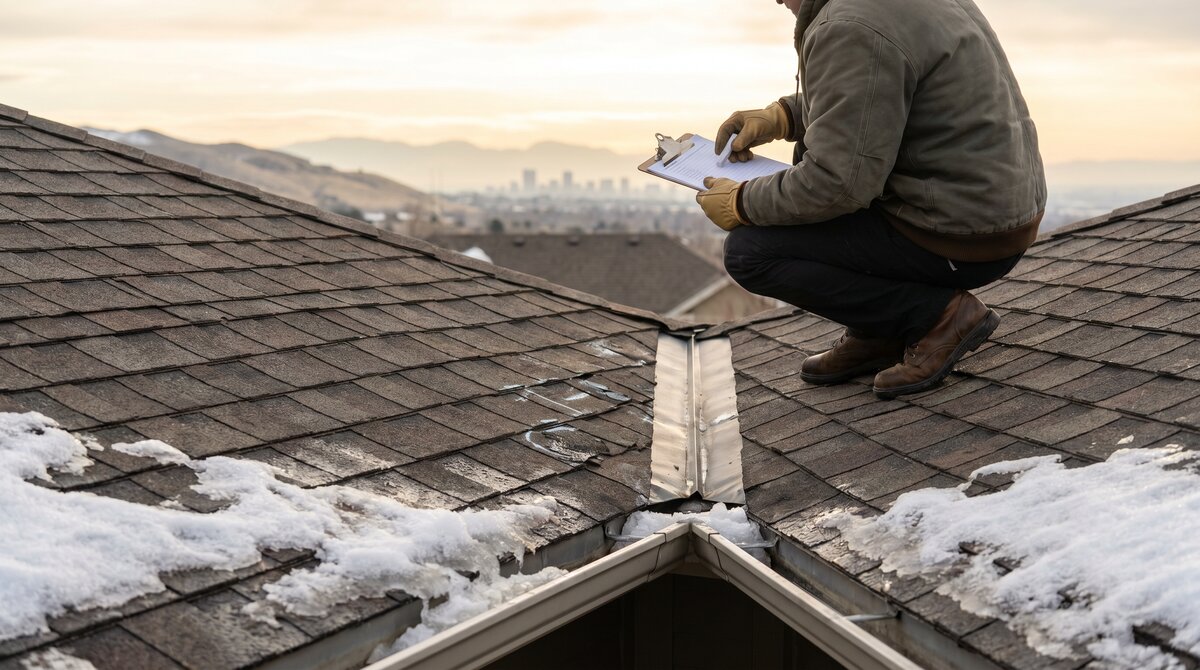
A proper post-chinook spring roof inspection in Calgary is a 45- to 90-minute walkover by a trained roofer. It covers the items chinook cycling damages, in priority order.
Step 1: Exterior walkaround. The inspector circles the house, photographing each elevation, noting visible shingle conditions, gutter alignment, and downspout integrity. Granules in downspouts are bagged for comparison.
Step 2: Ladder access to roof. Using fall protection and ladder stabilizers, the inspector accesses the lowest slope first, then works up to the ridge. Each slope gets a visual pass for lifted tabs, sealant failures, and granule loss patterns.
Step 3: Penetration audit. Every roof penetration — plumbing stack, furnace vent, attic exhaust, chimney, skylight — is checked individually. The boot collar is squeezed gently to confirm flexibility. Flashing edges are lifted with a thin tool to confirm bond. Caulk lines are visually inspected for cracks longer than 5 mm.
Step 4: Ridge cap walk. The ridge cap is walked end-to-end, checking for cracks, curls, missing granules, and lifted edges. Hip ridges receive the same treatment.
Step 5: Drip edge and gable trim. The inspector tugs gently on the drip edge along each eave and gable. Loose sections are flagged for refastening.
Step 6: Attic interior check. Where access permits, the underside of the roof deck is examined with a flashlight for water staining, mineral deposits, and active moisture. This often reveals leaks that have not yet shown up as ceiling stains downstairs.
Step 7: Written report and prioritized repair plan. The inspector produces a written report with photos, severity ratings, and recommended repair sequencing. This becomes the homeowner’s planning document — what to fix this season versus what can wait.
You can pair this inspection with the broader pre-summer envelope audit detailed in our residential exterior inspection checklist to catch fascia, soffit, eavestrough, and siding issues at the same visit. The Total Exteriors residential roofing page outlines what a follow-up repair scope typically includes.
Chinook Damage Repair Cost in Calgary (2026 Numbers)
Chinook-driven roof repairs are usually small, targeted jobs — which is good news for homeowners who catch them early. Here is what individual chinook-damage repairs cost in Calgary in 2026.
Sealant strip refresh (per slope): $250 to $550. Includes lifting and re-bonding shingle tabs along the bottom course with high-performance roofing adhesive. Typically takes 1 to 2 hours per slope.
Ridge cap replacement (full ridge): $400 to $900. Includes removal of the existing ridge caps, inspection of underlying ridge venting, and installation of new manufacturer-matched ridge caps.
Pipe boot replacement (per boot): $185 to $325. Includes lifting the surrounding shingles, removing the failed boot, installing a new high-temperature boot, and resealing all bonds.
Chimney or skylight flashing reset and re-caulk: $450 to $1,200. Includes lifting step flashing, cleaning old caulk, applying new high-grade urethane sealant, and resecuring the flashing edges.
Drip edge refastening (full perimeter): $300 to $750. Includes new ring-shank fasteners through the existing drip edge and any short sections replaced where corrosion is present.
Localized underlayment patch (one penetration): $400 to $900. Includes lifting surrounding shingles, cutting out damaged underlayment, installing new self-adhering membrane patch, and re-shingling the affected area.
A typical Calgary post-chinook repair visit combines two or three of these items into a half-day job, usually landing in the $800 to $2,200 range. Compared with the $9,500-plus cost of a full reroof prematurely triggered by ignored chinook damage, the math heavily favours catching things in their first season.
How to Minimize Chinook Damage on Your Calgary Roof
You cannot stop chinook cycles, but you can reduce how much damage they cause on your roof.
Install impact-resistant shingles at next replacement. Class 4 IR shingles use a more flexible reinforced mat that handles thermal cycling better than standard architectural shingles. The Alberta insurance premium discount adds a financial reason; the chinook resilience is the structural reason.
Use high-temperature pipe boots. Standard EPDM rubber pipe boots fail fastest. Specifying TPV or aluminium-shrouded “lifetime” boots adds about $75 per penetration to a reroof but typically lasts the full life of the shingles.
Confirm balanced attic ventilation. Inadequate intake or exhaust ventilation causes attic temperatures to swing more violently with chinooks. Confirm that the soffit-to-ridge ventilation ratio meets current Alberta Building Code (1:300 by default, 1:150 in some configurations).
Inspect every spring, repair small issues quickly. The single biggest factor in Calgary roof longevity is whether the homeowner catches small chinook-damage issues in their first season. A neglected drip edge becomes a damp fascia; a damp fascia becomes a rotten roof deck.
Choose Alberta-rated installation details. Manufacturer-default installation often skips Calgary-specific upgrades like extended ice and water shield, hand-sealed first courses, and ring-shank fasteners. Specify these with whoever installs your next roof.
Why Total Exteriors Handles Chinook-Cycle Damage Better
Total Exteriors has worked on Calgary roofs and exteriors for over two decades, and chinook-driven damage is one of the patterns we see every spring. Our inspectors are trained to find the freeze-thaw signatures that out-of-province crews miss, and our repair specifications are calibrated to Calgary’s specific climate rather than to manufacturer-default installation guidance written for milder regions.
We perform free post-chinook roof inspections, document everything photographically, and provide written repair plans with severity ratings so you can budget season-by-season instead of being pushed into a full reroof you do not need. We are certified installers for the major Canadian shingle manufacturers, carry Alberta WCB coverage and full liability insurance, and handle emergency repairs through our emergency call-out service when leaks emerge between scheduled visits. For homes considering Class 4 impact-resistant shingles at their next replacement, we can document the existing roof condition and the Alberta insurance discount paperwork your carrier will need.
Book your free Calgary chinook-damage roof inspection.
Spring assessment, written photo report, prioritized repair plan. No charge unless you choose us for the work.
Conclusion
Chinook damage to Calgary roofs is the slow, compounding cost of living in the most freeze-thaw-active city in Canada. Sealants, ridge caps, pipe boots, and flashing all fail earlier here than the manufacturer warranty suggests — but the individual repairs are small if you catch them in the spring window between winter and the summer storm season. A 60-minute post-chinook roof inspection with a Calgary-experienced roofer is the single highest-value preventive maintenance most homeowners can book, and the difference between $300 spring repairs and $3,000 fall leak callouts.
Frequently Asked Questions
How often should I inspect my Calgary roof for chinook damage?
Once a year, in the spring window between the last hard freeze and the first hail event — typically mid-April through early June. Calgary’s chinook cycles produce cumulative damage that is best caught annually, while individual repairs are still small.
How long do asphalt shingles really last in Calgary?
Calgary asphalt shingles typically reach 70 to 85 percent of their rated warranty life. A 30-year architectural shingle will usually need replacement at 22 to 26 years; sealant strips, ridge caps, and flashing components fail several years earlier and need targeted repair along the way.
Are Class 4 impact-resistant shingles better for Calgary chinook cycles?
Yes. Class 4 IR shingles use a more flexible reinforced mat that handles thermal expansion and contraction better than standard architectural shingles. The insurance discount they qualify for is incidental; the structural durability is the primary reason to specify them at your next replacement.
Do home insurance policies cover chinook damage in Alberta?
Generally no. Chinook damage is considered gradual wear-and-tear, not a sudden insured peril. Calgary insurance carriers cover damage from specific storm events (hail, wind, ice loading) but not the slow cumulative fatigue of freeze-thaw cycling. This is why spring repair budgets matter.
Can I do a chinook-damage roof inspection myself?
You can do the ground-level half — granules in gutters, lifted shingle edges from binocular distance, ceiling stain checks, attic inspection with a flashlight. The roof walk itself should be left to a roofer with fall protection and the trained eye for sealant and flashing failures.
What is the worst chinook damage I should never ignore?
A failed plumbing stack pipe boot, visible flashing separation at chimney or skylight, or any ceiling stain that has appeared or grown recently. These three are active or imminent leaks and tend to compound quickly — repair the same season they are spotted.