

After a big dump of wet spring snow, it is a fair question to ask while you look up at the roof: how much snow can a roof hold before it becomes a problem? In Calgary the answer is reassuring for most houses, but it depends far more on the type of snow than on how deep it looks, and some roofs are much more vulnerable than others.
This guide explains what the building code designs Calgary roofs to carry, how much different kinds of snow and ice weigh, which roofs are most at risk, the warning signs of too much weight, and how to remove snow safely.
Table of Contents
- How much snow can a roof hold? The short answer
- How much snow and ice actually weigh
- Why Calgary roofs usually cope, and when they do not
- Which roofs are most at risk
- Warning signs of too much snow load
- Should you clear snow off your roof?
- Checking the roof after a heavy winter
- Why Calgary homeowners call Total Exteriors
- Frequently Asked Questions
Key Takeaways
- Calgary’s building code ground snow load is 1.1 kPa, about 112 kg per square metre, and roofs are designed from that figure with safety margins built in.
- Weight depends on the type of snow: 30 cm of wet spring snow can weigh five times as much as 30 cm of fresh powder.
- Flat and low-slope roofs, roofs next to taller walls, older or damaged roofs, and add-ons like carports carry the most risk.
- Sagging ceilings, sticking doors, new drywall cracks and creaking sounds are signs to get off that floor and call a professional.
- Use a roof rake from the ground on sloped roofs; leave flat roof snow removal to professionals.
How much snow can a roof hold? The short answer
Roofs in Canada are designed for the snow expected where they are built. The National Building Code’s climatic data, maintained by the National Research Council of Canada, sets Calgary’s ground snow load at 1.1 kPa, with an extra 0.1 kPa allowance for rain on snow. That ground snow load is the weight of snow on the ground that has only a 1-in-50 chance of being exceeded in any given year, and 1.1 kPa works out to roughly 112 kg on every square metre, or about 23 pounds per square foot.
Engineers and builders use that number, adjusted for the roof’s shape and exposure, to size the rafters, trusses and sheathing, and the design includes safety margins. In practical terms, a sound house roof built to code in Calgary should carry a normal Calgary winter without trouble. Problems come from unusual loads: very wet snow, snow plus ice, snow drifting into one area, or a roof that is older, damaged or was never built properly.
How much snow and ice actually weigh
Depth tells you very little on its own. Fresh, fluffy snow is mostly air, while snow that has settled, been rained on or thawed and refrozen packs far more water into the same depth. These are typical approximate ranges for a 30 cm (about one foot) layer.
| Type of snow or ice | Approximate weight per square metre | Approximate lb per sq ft |
|---|---|---|
| 30 cm of fresh, dry snow | 15 to 30 kg | 3 to 6 lb |
| 30 cm of settled, packed snow | 60 to 90 kg | 12 to 18 lb |
| 30 cm of wet, heavy spring snow | 120 to 150 kg | 25 to 31 lb |
| 2.5 cm (1 inch) of ice | About 23 kg | About 5 lb |
| Calgary ground snow load (code) | About 112 kg | About 23 lb |
The comparison in the last row is the point. A foot of fresh powder is a small fraction of the design figure, but a foot of wet spring snow, or a few inches of ice under a layer of settled snow, can approach or exceed it. The Weather Network makes the same point: heavy, wet snow is the one to watch.
Why Calgary roofs usually cope, and when they do not
Calgary has a dry climate, and chinooks regularly melt the snow off roofs mid-winter, so the deep, months-long snowpack that loads roofs in places like Quebec or the Maritimes rarely builds up here. For most of the winter, snow weight is not the main risk to a Calgary roof; ice dams and freeze-thaw damage are.
The exceptions are worth knowing:
- Spring storms. March, April and May snowfalls in Calgary tend to be wet and heavy, sometimes arriving as rain on top of snow.
- Ice at the eaves. Ice dams concentrate a lot of weight on the overhang, the weakest part of the roof. Our guide to how Calgary winters damage your home exterior covers this.
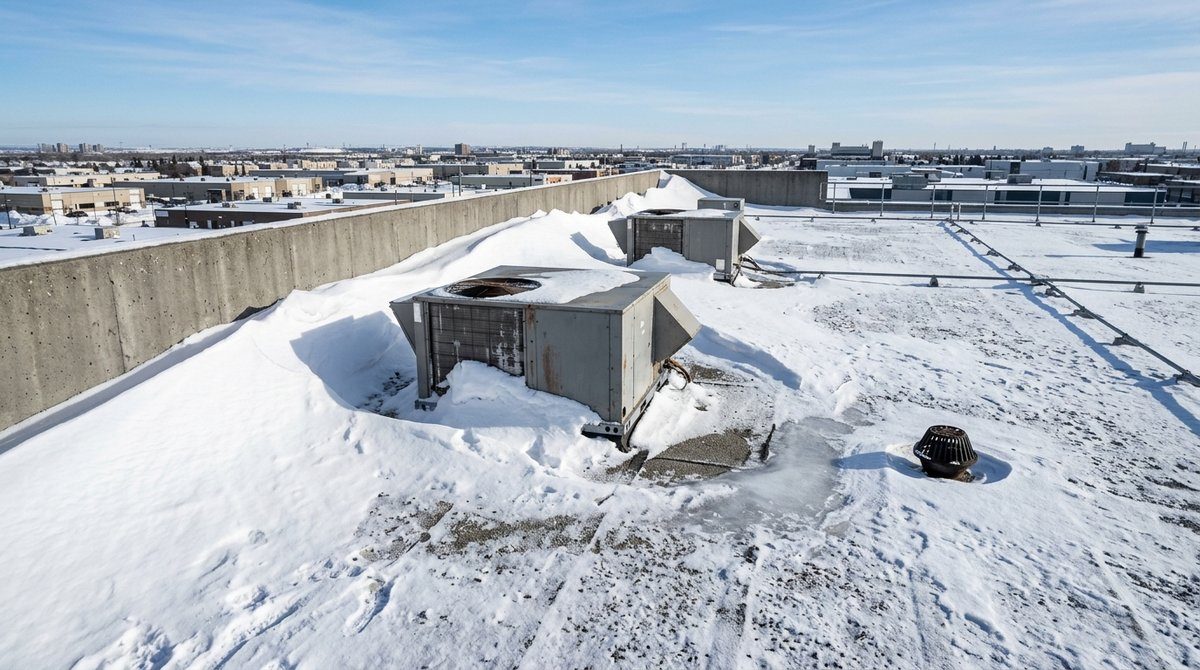
- Drifting. Wind piles snow against taller walls, in valleys, and behind parapets and rooftop equipment, creating loads several times heavier than the snow on the rest of the roof.
- Sliding snow. Snow sliding off a higher roof onto a lower one, such as a garage or porch roof, can suddenly double the load below.
Which roofs are most at risk
- Flat and low-slope roofs on garages, additions and commercial buildings hold snow instead of shedding it, and blocked drains let meltwater pond and refreeze. Our post on flat roof maintenance in Calgary explains how to keep drainage working.
- Older roofs and roofs with past leaks, where rot or water damage may have weakened the sheathing or framing.
- Add-ons and outbuildings such as carports, sheds, sunrooms, covered decks and pergolas, which are sometimes built lighter than the house.
- Roofs that have been altered, for example where framing was cut for a skylight or equipment without proper reinforcement.
Warning signs of too much snow load
- A sagging roofline or ceiling, or a ridge that no longer looks straight.
- Creaking, cracking or popping sounds from the roof or attic.
- Interior doors on the top floor that suddenly stick or will not latch.
- New cracks in drywall or plaster, especially above doors and near the ceiling.
- Leaks or water stains appearing during a cold spell.
- On flat roofs, ponding water or visible dips in the roof surface.
If you notice these signs, move people out of the rooms underneath, do not go onto the roof, and call a roofing contractor or structural engineer right away. For emergencies, our emergency call-out service is available 24/7.
Worried about the weight on your roof? Total Exteriors offers a 24/7 emergency service, so contact us right away. Stay off the roof and out of the rooms below until it has been checked.
Should you clear snow off your roof?
Most sloped house roofs in Calgary never need clearing. It makes sense after an unusually heavy or wet snowfall, where drifts have built up, or where ice dams keep forming at the eaves. If you do it:
- Stay on the ground. Use a long-handled roof rake from the ground rather than climbing onto the roof or working from a ladder.
- Leave a thin layer. Scraping down to the shingles strips granules and damages the roof.
- Work evenly. Removing all the snow from one side while leaving the other heavily loaded creates an unbalanced load.
- Watch for power lines and falling snow and ice, and keep people and pets clear of the drop zone.
- Leave flat roofs to professionals. Clearing a flat roof means walking on it, needs fall protection, and metal shovels can puncture the membrane. Keeping roof drains and scuppers clear matters as much as removing the snow.
For commercial buildings with large flat roofs, rooftop units and parapets, a snow management plan and regular inspections are part of normal maintenance. Our commercial flat roofs team works on these buildings year-round.
Checking the roof after a heavy winter
Heavy snow and ice can leave damage that only shows once the snow is gone: bent or loose eavestroughs, lifted shingles at the eaves, cracked flashing and damaged vents. A spring inspection catches it before summer storms find the weak spots. Our checklist of exterior repairs to schedule in spring covers what to look for, and if heavy snow or ice has damaged your roof, check your policy; many cover sudden damage caused by the weight of snow or ice, although coverage varies.
Why Calgary homeowners call Total Exteriors
Total Exteriors is a locally owned Calgary exterior contractor working on sloped and flat roofs for homes and commercial buildings, including residential roofing, residential flat roofs and commercial roofing. Our crews are licensed and insured, we offer a five-year workmanship warranty, and several insurance companies have given us approved contractor status.
We serve Calgary, Airdrie, Rocky View County, Beiseker, Chestermere, Cochrane, Crossfield and Irricana, with a 24/7 emergency line for the days when the weather does not wait.

Get your roof ready for winter. Book a roof inspection with Total Exteriors. Contact us online to get started.
Conclusion
How much snow can a roof hold in Calgary? A sound house roof built to code is designed around a ground snow load of about 112 kg per square metre, with safety margins, so a normal Calgary winter is not a threat. What changes the picture is heavy wet snow, ice at the eaves, drifting, and roofs that are flat, older, damaged or built lighter than the house. Watch for sagging, sticking doors and new cracks, use a roof rake from the ground when you need to, and leave flat roofs and anything that looks wrong to a professional.
Frequently Asked Questions
What is the snow load for roofs in Calgary?
The National Building Code’s climatic data gives Calgary a ground snow load of 1.1 kPa plus a 0.1 kPa rain load. Roof designs start from those figures and adjust for the roof’s shape, slope and exposure.
How many feet of snow can a roof hold?
It depends on the snow. A foot or more of fresh, dry snow is well within what a sound Calgary roof is designed for, while a foot of wet, heavy snow weighs about as much as the design ground snow load. Judge by the type of snow and the warning signs, not depth alone.
Should I shovel snow off my roof in Calgary?
Usually not. Clear snow only after unusually heavy or wet snowfall, or where drifts and ice dams build up, and do it with a roof rake from the ground. Do not climb onto a snowy roof.
Are flat roofs more at risk from snow?
Yes. They hold snow instead of shedding it, drifts collect behind parapets and equipment, and blocked drains let meltwater pond. Keep drains clear and have a professional handle snow removal.
What are the signs a roof might collapse from snow?
Sagging in the roofline or ceiling, creaking or cracking sounds, top-floor doors that suddenly stick, and new cracks in drywall. If you see these, leave the area underneath and call a professional immediately.
Does home insurance cover snow load damage?
Many policies cover sudden damage caused by the weight of snow or ice, but coverage and exclusions vary, especially where maintenance was neglected. Check your policy with your broker and photograph any damage.