
Quick answer: Vinyl siding in Calgary typically costs $6–$10 per square foot of wall, installed, in 2026. Siding a typical 2,000 sq ft house, which has about 1,800 sq ft of wall to cover, runs roughly $10,800–$18,000 for the base install, and closer to $20,000–$22,000 for a full replacement once removal of old siding, trim, sheathing repairs and scaffolding are counted.
Last updated: October 2026. These are typical Calgary ranges, not a quote. An on-site measure gives the real number for your home.
Vinyl Siding Cost by House Size
Siding is priced by the square foot of wall to be covered, not by the floor area of the house. To find yours, measure each wall (length × height), subtract windows and doors, and add the gable triangles. A two-storey home usually has more wall to side than a bungalow with the same floor area, because its walls are twice as tall. As a rule of thumb, this guide assumes a 2,000 sq ft house has about 1,800 sq ft of wall.
| Wall area to be sided | Typical base install cost ($6–$10 / sq ft) |
|---|---|
| 1,000 sq ft of wall | $6,000–$10,000 |
| 1,500 sq ft of wall | $9,000–$15,000 |
| About 1,800 sq ft of wall (a typical 2,000 sq ft house) | $10,800–$18,000 |
| 2,000 sq ft of wall | $12,000–$20,000 |
| 2,500 sq ft of wall | $15,000–$25,000 |
| 3,000 sq ft of wall | $18,000–$30,000 |
The base install covers vinyl panels, standard trim and accessories, and labour on a moderately complex home. It does not include the add-ons below.
Add-ons that raise the price
| Add-on | Typical allowance used in this guide |
|---|---|
| Extra trim, J-channel, corners, soffit, fascia and flashing | About 15–25% on top of the base install |
| Removal of old siding, prep and sheathing repairs | About 10–20% of the base cost |
| Scaffolding, site and contractor overhead | About 5–10% |
| Thicker-gauge, insulated or impact-rated vinyl | Upper end of the $6–$10 / sq ft range, or higher |
Worked example (from section 8): 1,800 sq ft of wall at $8 per sq ft is $14,400 for the base install. Adding 20% for trim and accessories, 15% for prep and repairs and 7% for overhead and scaffolding brings it to about $21,264. That is why a full replacement on a typical 2,000 sq ft house lands closer to $20,000–$22,000. Comparing materials? See our siding services, vinyl siding and Hardie board siding pages.
Table of Contents
- Introduction: Why Vinyl Siding Is Popular in Calgary
- Key Cost Drivers for Vinyl Siding Installation
- Typical Cost Ranges in Calgary & Alberta
- Cost Breakdown: Material, Labour, Prep, Extras
- Vinyl Siding & Hail / Storm Risk: What to Expect
- Comparing Vinyl to More Impact-Resistant Options
- Insurance, Claims & Matching Issues
- How to Estimate Your Specific Home
- Tips to Control Costs without Compromising Quality
- Choosing the Right Contractor (Total Exteriors’ Approach)
- Maintenance, Warranty & Lifespan Considerations
- Frequently Asked Questions
- Conclusion & Call to Action
New for 2026, jump to:
- 2026 Vinyl Siding Pricing in Calgary (table)
- Cost to Replace Vinyl Siding in Calgary
- Hail-Resistant Siding Options for Calgary Homes
- Hardie Board (Fibre Cement) vs Vinyl Siding
1. Introduction: Why Vinyl Siding Is Popular in Calgary
When homeowners in Calgary look to renovate or restore their exterior shell, vinyl siding often appears at the top of the list. It balances affordability, aesthetics, and ease of maintenance. For Total Exteriors Ltd., offering full exterior restoration (roofing, siding, soffits, eavestrough, cladding) after hail, wind, or storm damage, vinyl siding is one of our go-to materials where conditions make sense.
However, choosing vinyl doesn’t mean it’s a one-size-fits-all decision. Because of Calgary’s unique weather — severe hail, high winds, freeze-thaw cycles — the cost and design decisions must factor in resilience, warranties, and insurance. In this detailed guide, we break down what it costs to install vinyl siding on a Calgary home, how hail and storm exposure change that cost, and what you should watch out for.
By the end of this post, you will have a clear understanding of realistic pricing, value factors, and how Total Exteriors can deliver a durable solution.
2026 Vinyl Siding Pricing in Calgary
The table below pulls together the figures used throughout this guide. Treat them as typical Calgary ranges in 2026, not a quote. Wall area, number of storeys, trim detail, siding grade and what turns up under the old siding all move the final price.
| Project | Typical Installed Range (CAD) | What’s Included |
|---|---|---|
| Per square foot of wall, installed | $6–$10 / sq ft | Vinyl panels, standard trim and accessories, and labour on a moderately complex home |
| Smaller home or bungalow (approx. 1,200 sq ft of wall) | $7,200–$12,000 | Base install, calculated at $6–$10 per sq ft of wall area |
| Typical 2,000 sq ft home (approx. 1,800 sq ft of wall) | $10,800–$18,000 | Base install. Does not include extra repairs, insulation or structural fixes |
| Larger two-storey (approx. 2,500 sq ft of wall) | $15,000–$25,000 | Base install, calculated at $6–$10 per sq ft. Second-storey access and scaffolding push jobs toward the upper end |
| Full replacement with allowances (1,800 sq ft of wall at $8 / sq ft) | $20,000–$22,000 | Trim and accessory allowance, removal of old siding, prep and sheathing repair buffer, scaffolding and overhead. See the worked example in section 8 |
| Thicker-gauge, insulated or impact-rated vinyl | Upper end of the ranges above, or higher | Heavier panels that resist denting and cracking better. The premium depends on the product line chosen |
Material alone is a small part of these numbers. Base panels run about $0.80 to $2.00+ per square foot, and labour typically runs $2–$6+ per square foot, as broken down in section 4.
2. Key Cost Drivers for Vinyl Siding Installation
Before jumping into numbers, it’s crucial to understand what drives the cost of a vinyl siding project. Two homes of identical square footage can differ by tens of thousands of dollars in quote, based on these variables:
| Cost Factor | Impact on Price | Notes / Considerations |
|---|---|---|
| Quality & thickness of vinyl | Higher grade, insulated or impact-resistant siding costs more per panel | Thicker siding resists denting and fading better |
| Home size & shape / number of storeys | More wall area, more corners, gables, dormers complicate installation | Complex roofline or second floors add labour |
| Removal / disposal of old siding | Older materials (asbestos or wood) or multiple layers raise cost | Also includes disposal fees |
| Wall sheathing, insulation, structural repairs | If sheathing is damaged or siding removal reveals rot or mold, additional cost is triggered | Investing in proper backing helps long term |
| Trim, flashing, trim details, soffits, fascia | Corners, windows, door trim, trim boards, returns, etc. all add labour and materials | Flashing and caulking are essential to prevent water ingress |
| Accessibility / scaffolding / site conditions | Tight lots, multi-level, landscaping constraints may require extra scaffolding or lifts | Adds to labour overhead |
| Permits, inspection, warranty, overhead | Some jurisdictions require permits; contractors may include premium for warranty, job logistics | Choose a reputable contractor with proper insurance |
| Weather / seasonal adjustments / supply costs | Volatile material costs or seasonal demand can affect quotes | In Calgary, off-peak season projects might be slightly discounted |
When you know which levers drive cost, it’s easier to evaluate quotes and manage expectations.
3. Typical Cost Ranges in Calgary & Alberta
To anchor expectations, here are industry averages and comparators:
- In general Canadian context, some sources place vinyl siding cost around CAD $6–$10/sq ft including installation.
Putting that into context: for a 2,000 sq. ft. home (assuming approx. 1,800 sq. ft. of exterior wall coverage after deductions for windows/doors), vinyl siding installed might cost in the range of CAD $10,800 to $18,000, not including extra repairs, insulation, or structural fixes.
Beware: Some contractors quote low “material cost only” or “panel replacement only” jobs. A full exterior replacement (removing old siding, repairing sheathing, flashing, finishing edges) is more comprehensive.
4. Cost Breakdown: Material, Labour, Prep, Extras
To demystify the pricing further, here’s how costs generally split:
4.1 Material Costs (Vinyl Panels, Accessories, Trim)
- Base vinyl panels: moderate grades often cost $0.80 to $2.00+ per square foot (CAD) depending on thickness, embossing, UV protection, colour.
- Trim, J-channels, soffit, fascia, corner posts, starter strips, trimboard: often add 15–25% over panel cost.
- Accessories: flashing, caulking, underlayment, vapor barrier—small per-foot items but add up over the whole house.
4.2 Labour Costs
- Labor can be a major chunk — installing, aligning, cutting, flashing, trimming, caulking, finishing edges, cleanup.
- In Calgary, labour pricing typically aims at the $2–$6+ per sq ft range (depending on difficulty, accessibility). Some DIY or “light-labour” quotes might suggest lower, but quality and warranty suffer.
- Removal and disposal of old siding is labour‐intensive work too — expect additional cost per sq ft or per square (100 sq ft) for that.
4.3 Preparation, Repairs & Sheathing
- If the underlying sheathing (OSB, plywood, etc.) is deteriorated, wet, moldy, or bowed, repair or replacement is required.
- Insulation upgrades, building wrap, moisture barriers, furring strips or strapping (for ventilation) may be needed.
- Structural reinforcement or leveling (especially around windows, corners) can add to cost.
4.4 Extras, Overheads & Contingencies
- Permits, inspections, scaffolding, lifts, fire safety, waste disposal fees.
- Contractor markup, overhead, warranty cost.
- Contingency buffer—unexpected rot, water damage, misalignment, hidden issues under siding.
Example cost allocation (ballpark percentages):
- Material & trim: 30–40%
- Labour: 35–50%
- Prep / repair / sheathing: 10–20%
- Overhead / waste / contingencies: 5–10%
So, for a $15,000 job, you might expect ~$4,500–$6,000 in materials + trim, $5,500–$7,500 in labour, and ~$2,000–$3,000 in prep, repairs, scaffolding, etc.
Cost to Replace Vinyl Siding in Calgary
Replacing vinyl siding costs more than siding a new build, because the old cladding has to come off first and nobody knows what the wall looks like until it does. As a typical Calgary range in 2026, a full replacement on an average detached home falls between the $10,800–$18,000 base install range and the $20,000–$22,000 worked example in section 8. Where you land depends on how much removal, repair and trim work the house needs. An on-site measure gives the real number.
Here is what replacement adds to the bill:
- Removal and disposal of old siding. Tear-off is labour, plus bin and landfill fees. Multiple layers, or older wood or asbestos-containing material underneath, raise the price.
- Sheathing and house wrap repairs. With the panels off, it is common to find torn or missing house wrap, soft OSB around windows, or water staining below failed flashing. Budget 10–20% of the base cost for removal and repairs, the same buffer used in our estimate method.
- Partial vs full replacement. Replacing one wall or a handful of panels costs less up front and suits isolated damage. Per square foot it often costs more, because set-up, trim and mobilization are spread over less area.
- Colour matching on partial jobs. Vinyl fades. New panels beside ten-year-old panels rarely match, and a discontinued profile cannot be matched at all. Many homeowners end up replacing a full elevation so the house looks uniform from the street.
- Replacement vs new-build installation. On a new build the walls are bare, wrapped and ready. There is no tear-off, no disposal and few surprises, so pricing sits at the lower end of the range. Replacement means working around landscaping, decks, lights and meters, and re-flashing existing windows and doors.
If your roof is also near the end of its life, pricing both jobs together can save on mobilization and scaffolding. Our guide to the cost of installing a new roof in Calgary covers that side of the budget.
5. Vinyl Siding & Hail / Storm Risk: What to Expect
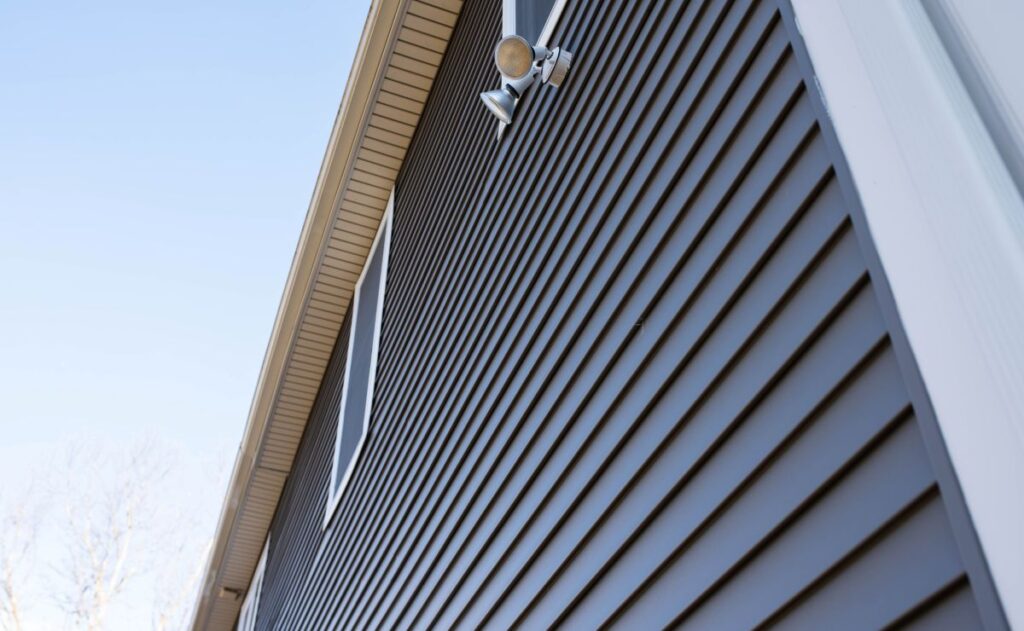
One of the biggest variables facing Calgary homeowners is hail. Vinyl siding, though cost-effective, has trade-offs in hail-prone regions. Here’s what to know:
5.1 Recognizing Hail Damage on Vinyl
Not all damage is obvious. Some signs are subtle:
- Cracks or splits parallel to the siding, or semicircular fissures between ridges.
- Chipping at the bottom edge of panel ridges (a half-circle chip).
- Dents or puckering in the panel surface.
- Discolouration, stress lines, or brittleness over time (due to UV aging) which makes siding more fragile.
- Compare multiple panels on a face — if clustered hits on one wall exist, likely hail.
- Note: some damage below waist level or near mower height might be mechanical (rock chips) rather than hail.
A careful visual and tactile inspection is critical. Professionals often inspect siding right after storms, looking for consistent damage patterns.
5.2 Vinyl’s Vulnerability to Hail
- According to sources, vinyl siding has a “low hail impact resistance rating” compared to more rigid materials like steel or fibre cement.
- Even moderate hail can crack or fracture vinyl siding.
- As vinyl ages, it becomes more brittle, making it more susceptible to damage in hail or freeze-thaw cycles.
- Once a panel is cracked or chipped, water and moisture ingress behind the siding becomes a risk, potentially causing mold or wood rot.
5.3 Mitigating Hail Impact
There are ways to reduce risk or improve resilience:
- Choose thicker / impact-rated vinyl siding — heavier gauge siding with enhanced UV and impact modifiers.
- Insulated vinyl siding — some vinyl products include a continuous rigid foam backing fused to vinyl, increasing rigidity and impact absorption (R-values also increase).
- Strategic landscaping / protective features — planting shrubs, installing awnings, or shading vulnerable walls can deflect hail.
- Enhanced flashing, better fastening, and quality installation — ensuring panels are properly anchored, snapped, and sealed reduces flap or blow-off risk in high winds.
- Alternative siding materials — if hail is a recurring issue, homeowners may opt for more durable siding options (steel, fiber cement) as a long-term upgrade.
Hail-Resistant Siding Options for Calgary Homes
Calgary sees hail most summers, so siding choice matters more here than in most Canadian cities. No siding is hail-proof. Some materials handle it much better than others.
How standard vinyl behaves in hail. Small hail usually leaves no mark. Larger stones can crack, chip or punch through panels, and the risk climbs as vinyl ages and turns brittle. The walls facing the storm take most of the damage, which is why hail claims often involve one or two elevations and not the whole house.
Thicker-gauge and impact-rated vinyl. Heavier panels flex less and resist cracking better than builder-grade vinyl. Insulated vinyl adds a foam backing that supports the face of the panel. Both sit at the upper end of the $6–$10 per square foot installed range or above it. They reduce damage. They do not eliminate it.
Fibre cement and engineered wood. Hardie board (fibre cement) siding is rigid and handles most hail without cracking, though it can chip under severe impact. It typically runs $7–$14+ per square foot installed. Engineered wood and smart board cladding is built with impact resistance in mind and usually carries a premium over vinyl. Steel siding is another strong option at roughly $10–$16+ per square foot installed.
What insurers typically cover. Most policies cover sudden hail damage to siding, less your deductible. Some insurers pay only for the damaged elevations, and matching rules differ from policy to policy, so check your wording or ask your broker. Many homeowners use a claim as the time to upgrade to a tougher material and pay the difference themselves.
Not sure whether your siding took damage in the last storm? Total Exteriors offers a free inspection by a HAAG-certified inspector. Call (403) 313-4932 and we will document what we find in a format your insurer can use.
6. Comparing Vinyl to More Impact-Resistant Options
To make a truly informed decision, it helps to compare vinyl against alternatives that are better suited to hail and storm exposure. Even if you ultimately choose vinyl, knowing the trade-offs helps you compare quotes and defend your choice.
| Material | Typical Installed Cost* | Hail / Impact Resilience | Lifespan / Maintenance | Pros & Cons |
|---|---|---|---|---|
| Vinyl (standard or insulated) | CAD $6–$10 / sq ft (installed) | Moderate / Low, susceptible to cracking & dents | 20–30+ years (depending on quality) | Low cost, easy install; less durable under hail exposure |
| Fiber Cement / Hardie Board / James Hardie | CAD $7–$14+ / sq ft installed (depending on complexity) | Good resistance, better than vinyl, may chip under severe impact | 30–50+ years (with proper maintenance) | Better impact resistance, texture options; heavier, more labour intensive |
| Steel / Metal Siding | Roughly CAD $10–$16+ / sq ft (installed, depending on gauge) (Canadian estimates similar to US) | Excellent resilience to hail (less cracking) | 40+ years | Highly durable, low maintenance, fewer dent risks; may show dents in extreme cases |
| Engineered / Composite / High-Impact Siding | Variable; potentially 1.2×–2× premium over vinyl | Very good, designed with impact resistance in mind | Long life, moderate maintenance | Offers improved durability, but costlier upfront |
| Brick, Stone, Masonry Veneer | High (CAD $20+/sq ft or more) | Excellent, essentially immune to hail | 50+ years or more | Highest durability, premium look, high cost and structural support needed |
* Costs are approximate and depend heavily on location, complexity, and contractor.
While vinyl is often an effective choice in many Calgary homes, for areas with frequent hail events or for homeowners prioritizing durability, investing in fiber cement, steel, or impact-rated siding can pay off in fewer repairs and lower risk over the long run.
Hardie Board (Fibre Cement) vs Vinyl Siding: Side-by-Side
Hardie board is the alternative Calgary homeowners ask about most. Here is how it compares with vinyl on the points that matter. More detail is on our Hardie board siding page.
| Factor | Vinyl Siding | Hardie Board (Fibre Cement) |
|---|---|---|
| Cost level | Lowest of the common options. CAD $6–$10 / sq ft installed | Higher. CAD $7–$14+ / sq ft installed, depending on complexity |
| Lifespan | 20–30+ years, depending on quality | 30–50+ years with proper maintenance |
| Hail resistance | Moderate to low. Can crack or chip, more so as it ages | Good. Better than vinyl, may chip under severe impact |
| Maintenance | Gentle washing and prompt replacement of damaged panels. No painting | Periodic caulking checks and eventual repainting |
| Look | Wide colour range, lap and board-and-batten profiles. Colour fades over time | Deeper wood-grain texture and crisp lines. Can be repainted a new colour |
| Best for | Tight budgets, rental properties, quick insurance repairs, sheltered walls | Long-term owners, hail-exposed elevations, homeowners who want a premium finish |
7. Insurance, Claims & Matching Issues
Because Total Exteriors often works in post-storm remediation, insurance considerations are key. Understanding how insurers view siding replacement, matching, and claims can make the difference between a stress-free rebuild and budget blowouts.
7.1 When Insurance Covers Siding Damage
- Most homeowner policies cover “direct physical loss” from hail or wind if you file promptly and document the damage.
- The burden is on the homeowner to provide evidence (photos, dated storm records, professional inspection).
- Some policies have matching / uniform appearance clauses; others don’t. If your siding color or profile is discontinued, replacement may lead to mismatched walls.
- In some cases, insurers will only replace the damaged portion / side and refuse to replace undamaged sides even for color matching.
For example, a homeowner posted this experience:
“My adjuster is saying they don’t have to replace the other 2 undamaged sides of the house and that the replacement vinyl doesn’t have to color match.”
Thus, working with an experienced contractor who can negotiate with adjusters and document matching issues is beneficial.
7.2 Matching / Uniform Appearance Challenges
- Vinyl siding fades over time. New panels will appear brighter or slightly off in hue compared to aging siding.
- When siding lines or profiles are discontinued, matching becomes impossible.
- To get visual consistency, an insurer may require full wall replacement rather than patching just the damaged portion.
- Some homeowners choose to replace all siding on a façade or the entire house themselves, covering the difference beyond what insurance pays.
7.3 Role of Contractor in Insurance Claim
A skilled siding / exterior restoration contractor (like Total Exteriors) can:
- Perform a professional storm damage inspection and provide a damage report to insurers
- Walk the premises with adjusters to point out hidden damage
- Provide uniform pricing and match colours, or show equivalency to argue replacement value
- Manage change orders, unit pricing, and contingency claims
- Mitigate exposure to underpayment or scope shrinkage by insurers
Proper documentation, high-quality work, and transparent communication increase the chances that you will be fully compensated for the restoration required.
8. How to Estimate Your Specific Home
Here’s a step-by-step method you can use to produce a rough estimate for vinyl siding installation in Calgary:
- Measure or get the exterior wall area
- Measure each wall (length × height) minus windows/doors
- For gables, measure triangles and add
- Sum total exposed wall area in square feet
- Decide on siding grade / thickness
- Standard, thick, insulated, impact-rated etc.
- Choose trim & accessory budget
- Estimate additional 15–25% over panel area for trim, soffits, fascia, flashings
- Apply a per-square-foot installed cost
- Use $6–$10 CAD/ft² baseline (for moderately complex jobs)
- Multiply by wall area
- Add preparation & repair buffer
- Add 10–20% of the base cost for repairs, sheathing, old siding removal
- Add scaffolding / site overhead / contractor overhead
- Add fixed or percentage overhead (e.g. 5–10%)
- Review with contractor / get quotes
- Compare with local quotes
- Adjust for complex features, multi-level, difficult access
Example:
- Home wall area (after subtracting windows/doors): 1,800 ft²
- Base installed cost: $8/ft² → 1,800 × 8 = $14,400
- Trim & accessory allowance (20%): + $2,880 → $17,280
- Repair / prep allowance (15%): + $2,592 → $19,872
- Overhead / scaffolding (7%): + $1,392 → ~ $21,264
So that home might expect a ballpark install cost of CAD $20,000–$22,000 for a full, high-quality vinyl siding replacement with allowances.
9. Tips to Control Costs Without Compromising Quality
While you want durability and aesthetics, there are smart ways to optimize budget:
- Phased renovation: Replace one side at a time, or upgrade only most-exposed walls (e.g., south or west facing).
- Simplify design / reduce complexity: Fewer corners, simpler rooflines, less custom trim.
- Negotiate trim package: Use standard trim sizes or fewer colors to save on custom trim.
- Use efficient access / staging: Plan scaffolding and staging well to reduce crew travel time.
- Bundle other exterior work: Combining siding with roof, soffit, eaves, gutters often yields discounts on mobilization.
- Choose mid-tier rather than premium grade vinyl: A strong mid-grade product often balances performance and cost.
- Arrange timely demolition / removal: Handling removal early avoids delays, rework, or storage cost.
- Have contingency funds: Expect surprises, but plan for them (e.g., 5–10% buffer).
- Get competitive bids, check references: Don’t simply pick lowest price; inspect quality, warranty, reputation.
10. Choosing the Right Contractor (Total Exteriors’ Approach)
Here is how Total Exteriors positions itself as the trusted partner in Calgary for exterior restoration and siding work:
- Full-scope exterior remediation expertise
- Because we handle roofing, siding, soffits, eavestrough, cladding, we see the full envelope and holistically restore after storms.
- We understand how siding interacts with roof edges, flashing, gutter connections—vital for long-term performance.
- Storm & insurance experience
- We regularly work with adjusters and clients on hail, wind, or storm damage jobs.
- Our documentation, inspection reports, and scope definitions help ensure insurance claims are fair and complete.
- Quality materials & impact mitigation
- We source vinyl siding options with better UV stabilizers, thicker gauge, or backed with insulative cores.
- Our installation practices (secure fastening, recommended trim, flashing, moisture barriers) reduce risk under heavy storm events.
- Transparency in quoting & change management
- We break down cost line items (material, labour, repair, overhead).
- We include documented allowances for contingencies and make change orders visible.
- Warranty and post-project service
- We support warranties, inspect work thoroughly, and correct issues promptly.
- Our reputation depends on lasting performance, not “lowest bid and disappearing.”
- Local knowledge & Calgary conditions
- We understand freeze-thaw, extreme temperature swings, snow load, hail zones, wind loads in Calgary.
- Our crew experience is in local climate; no surprises.
Once you understand why quality and proper installation matter, it is easier to see value beyond the per-foot quote.
11. Maintenance, Warranty & Lifespan Considerations

Choosing vinyl siding is not “install and forget.” Performance over decades depends on maintenance, warranties, and expected lifespan:
11.1 Typical Lifespan
- Good-quality vinyl siding, properly installed and maintained, can last 20–30+ years (some premium lines claim higher).
- In hail-prone or extreme climates, replacement or repair may be necessary earlier for some panels.
11.2 Warranties
- Most vinyl siding products carry manufacturer warranties (often 25, 30 years, or lifetime limited).
- Warranties may cover fading, warping, material defects—but not damage from hail or impact.
- Your contractor may provide a workmanship warranty (e.g. 5–10 years).
- Always ensure warranties are transferred to the homeowner and properly documented.
11.3 Maintenance Tips
- Clean siding periodically (gentle washing, not power washing).
- Inspect after storms for cracks, chips, and seal gaps.
- Re-caulk joints and flashing as needed to maintain watertightness.
- Replace damaged panels promptly to prevent water intrusion behind walls.
- Trim landscaping and trees that could rub or hit siding.
Maintenance and prompt repairs help extend service life and protect underlying structure.
12. Frequently Asked Questions
Will my insurance pay for full siding replacement after hail?
It depends on your policy. If hail damage is documented as “direct physical loss,” your insurer should cover repair or replacement. But many insurers only pay for the damaged portion, not entire walls, unless matching provisions or uniform appearance clauses apply.
Why do quotes vary so much between contractors?
Because of differences in material grade, labour expertise, trim detail, warranty, site conditions, and risk buffers. The lowest bid may cut corners on flashings, fastening, moisture barrier, or warranty.
Should I choose fiber cement or steel instead of vinyl given hail risk?
In hail-prone areas, selecting more impact-resistant siding (fiber cement, steel, composite) may reduce long-term repair costs. But the cost is higher upfront. If you are balancing budget against longevity, ask for both options on your quote and compare them over the life of the siding.
What is insulated vinyl siding, and is it worth the extra cost?
Insulated siding integrates a rigid foam backing to the vinyl panel, improving rigidity, reducing buckling, and slightly boosting insulation (R-value). In some cases it offers better performance under hail. It’s costlier, but valuable in certain conditions.
How soon should I replace siding after hail damage?
Report damage promptly to your insurer. A timely inspection helps preserve legitimate claim rights. Delaying replacement can allow water intrusion, mold, rot, and hidden structural issues.
How much does siding cost for a 2,000 sq ft house?
A typical 2,000 sq ft house has about 1,800 sq ft of wall to side. At $6–$10 per square foot installed, vinyl siding comes to roughly $10,800–$18,000 for the base install. With removal of the old siding, extra trim, sheathing repairs and scaffolding, a full replacement on that house is closer to $20,000–$22,000. A two-storey usually has more wall area than a bungalow of the same size, so measure the walls, not the floor.
How much is vinyl siding per square foot in Calgary?
About $6–$10 per square foot of wall, installed, in 2026. Of that, the vinyl panels themselves are about $0.80 to $2.00+ per square foot and labour typically runs $2 to $6+ per square foot. Trim, accessories, prep and overhead make up the rest. Thicker-gauge, insulated or impact-rated vinyl sits at the upper end of the range or above it.
How much does it cost to replace vinyl siding in Calgary?
As a typical 2026 range, expect CAD $6–$10 per square foot installed, or about $10,800–$18,000 for the base install on a typical 2,000 sq. ft. home. With removal of old siding, trim, sheathing repairs and scaffolding included, a full replacement on that home is closer to $20,000–$22,000. An on-site measure gives the real number.
Is vinyl siding hail resistant?
Only partly. Standard vinyl handles small hail but can crack or chip under larger stones, and it gets more brittle with age. Thicker-gauge, insulated or impact-rated vinyl holds up better, and fibre cement, engineered wood and steel hold up better again.
Is Hardie board worth the extra cost over vinyl in Calgary?
It can be if you plan to stay in the home and your walls are exposed to hail. Fibre cement typically costs $7–$14+ per square foot installed against $6–$10 for vinyl, and it lasts longer and resists impact better. On a tight budget or a sheltered wall, a good mid-grade vinyl is still a sound choice.
13. Conclusion & Call to Action
Installing new vinyl siding on a Calgary home is more than just slapping on panels — it’s about resilient design, quality installation, and storm-aware decision-making. While vinyl remains one of the most cost-effective siding options, the unique weather challenges of Calgary (hail, wind, freeze-thaw) demand thoughtful material selection, installation quality, and a contractor experienced in exterior remediation.
At Total Exteriors Ltd., we specialize in full exterior restoration and replacement after storm, wind, or hail damage. We guide clients through insurance claims, material selection, durability trade-offs, and deliver high-quality workmanship backed with warranty support. If you’re considering vinyl siding replacement — or exploring more impact-resistant options — we’re ready to help with a no-obligation consultation, damage inspection, and tailored quote.
Contact Total Exteriors today to arrange a free site assessment and get a professional estimate for your Calgary home’s siding restoration.
Prefer to talk it through? Call (403) 313-4932 to book a free inspection with a HAAG-certified inspector. Total Exteriors has been in business since 2014 and BBB A+ accredited since 2017.